Pallets
Thermoformed Pallets: How They Are Made and How They Differ From Wood Pallets
Heat and EPS versus boards and nails. How the manufacturing process decides your pallet's weight, moisture, surface and paperwork at the border.
Read Article
BlogPallets
In our example, a 48-foot dry van holds 24 to 28 pallets of 39.4 × 47.2 in (100 × 120 cm) on a single level, depending on the loading pattern. Clear width, height and weight decide the final number.
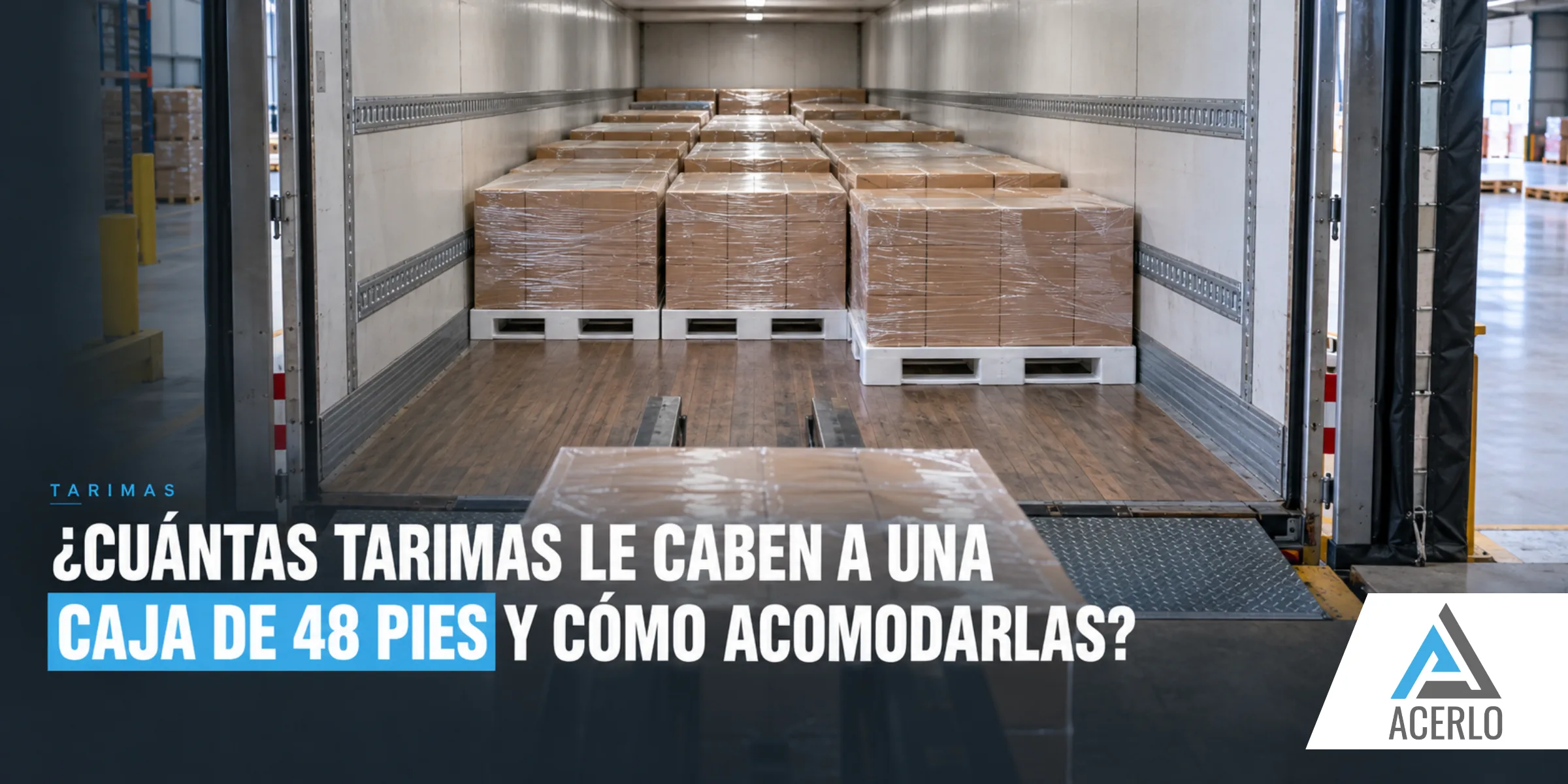
An auto parts plant in Saltillo schedules a shipment of 28 pallets measuring 39.4 × 47.2 in (100 × 120 cm) to an assembly plant in San Luis Potosí in a single 48-foot dry van, because the carrier told them “28 always fit.” The trailer that shows up has logistics track on its walls, and two turned pallets no longer fit side by side. The forklift operator loads them straight and, by the time he reaches the doors, four pallets are left on the dock.
The four pallets wait until the next day, when a second truck goes out just to move them. The assembly plant receives an incomplete order and logs the partial delivery in its supplier scorecard, and the plant pays a full freight charge for four positions. All of it could have been solved with a tape measure, the trailer's interior dimensions and ten minutes of math before scheduling the shipment.
How many pallets fit in a 48-foot trailer depends on five things: the trailer's clear length and width, the pallet size, the loading pattern you choose, the load height and the weight of each loaded pallet. A number from memory only holds for the trailer and the load it was calculated with. Here we do the math step by step, and every figure is an illustrative example with stated assumptions.
A 48-foot trailer measures 48 ft (14.63 m) on the outside, and its interior dimensions vary with the manufacturer, the walls and the logistics track or posts. For the example we assume about 571 in (14.5 m) of interior length, 97.6 in (2.48 m) of clear width and 102.4 in (2.6 m) of clear height. Before you plan, ask for those dimensions on the unit you will receive, or measure them at the dock, along with the height of the rear door opening, which is usually lower than the interior.
A pallet that fits on paper with less than half an inch (1 cm) to spare rarely fits the same way with a forklift, because the operator needs room to avoid scraping the walls and the stretch wrap sticks out past the edge. In the example we flag as tight any pattern that leaves less than 2 in (5 cm) free across the width.
With the 39.4 × 47.2 in (100 × 120 cm) pallet, the most used in Mexico, the same trailer allows three single-level patterns, with a difference of four pallets between the first and the last.
If you place the 47.2 in (1.20 m) side along the length of the trailer, each row carries two pallets that take up 78.7 in (2.00 m) of width, leaving 18.9 in (48 cm) free. In 571 in (14.5 m) of length, 12 rows fit, totaling 566.9 in (14.40 m) and leaving about 4 in (10 cm) at the nose. The result is 24 pallets. It is the easiest pattern to load.
If you turn the pallets so the 39.4 in (1.00 m) side runs along the trailer, each row of two takes up 94.5 in (2.40 m) of width and leaves 3.1 in (8 cm) free in our 97.6 in (2.48 m) trailer. In 571 in (14.5 m), 14 rows fit, totaling 551.2 in (14.00 m) and leaving about 20 in (50 cm) at the nose. The result is 28 pallets, four more than straight. This is the pattern that failed in Saltillo, because the logistics track brought the clear width below 94.5 in (2.40 m) plus clearance.
When the trailer does not allow you to turn them all, the alternating pattern is the one to use. On each side of the trailer, a straight pallet alternates with a turned one, and the pallets on the opposite side go the other way, so two turned pallets never sit side by side. That way, the maximum width the load takes up is 86.6 in (2.20 m), the sum of 39.4 and 47.2 in (1.00 and 1.20 m).
In our trailer, one side carries 7 straight pallets and 6 turned ones, totaling 566.9 in (14.40 m); the other carries 7 turned and 6 straight, totaling 559.1 in (14.20 m). That is 13 pallets per side and 26 in all, two more than straight, with 11 in (28 cm) free across the width.
The 48 × 40 in pallet, the most common in the United States, measures 121.9 × 101.6 cm. With the same trailer, 571 in long and 97.6 in of clear width, the math works out like this:
Turned, this pallet is so tight that it will probably not fit in a trailer with logistics track, and the trip then carries 22 pallets instead of 28. Calculate each pallet size separately and with the real clear width.
If the product and its packaging allow it, you can place one loaded pallet on top of another. With our assumption of 102.4 in (2.6 m) of clear height, two pallets up to 49.2 in (1.25 m) high each add up to 98.4 in (2.50 m) and leave about 4 in (10 cm) of clearance for the maneuver. With the Stiropallet plastic pallet, which is 5.3 in (13.5 cm) high, that leaves up to 43.9 in (1.115 m) for product on each level. With double stacking, the 24 straight positions become 48 pallets and the 28 turned positions, 56.
In double stacking, the boxes on the bottom level carry the weight of the top pallet through every braking and every pothole. If the packaging gives, the load arrives crushed and the customer can reject the entire level. Check that your boxes can take that weight and that the bottom load stays flat; a corrugated plastic sheet on top helps spread the support. If you plan to double stack the Stiropallet plastic pallet in the truck, we review the case with you before the first shipment.
In Mexico, the NOM-012-SCT-2 standard sets the maximum gross vehicle weight and dimensions according to the vehicle configuration and the type of road. From that weight you subtract the weight of the tractor and the trailer, and what remains is the payload your carrier can accept on that trip.
For the example we assume a payload of about 44,100 lb (20,000 kg), a round metric figure to keep the math simple. Divided by the positions, it gives the maximum average weight per pallet: about 1,837 lb (833 kg) with 24 positions, about 1,575 lb (714 kg) with 28 and about 787 lb (357 kg) with 56 double stacked. If your loaded pallet weighs more than that average, weight sets the limit; if it weighs less, space does.
With pallets of about 1,985 lb (900 kg), like those of steel, beverages or building materials, 22 pallets fit, totaling about 43,650 lb (19,800 kg), and two floor positions stay empty even if you load them straight. With that load, also check the dynamic load rating of your pallet: on the Stiropallet plastic pallet it is 1,760 lb (800 kg). With pallets of about 660 lb (300 kg), on the other hand, the 56 double-stacked positions add up to about 37,040 lb (16,800 kg), and space runs out before the payload does.
When the shipment maxes out on weight, every pound of pallet takes the place of a pound of product. A 39.4 × 47.2 in (100 × 120 cm) wood pallet weighs 33 to 55 lb (15 to 25 kg), and the Stiropallet plastic pallet, 9.9 lb (4.5 kg). With the lightest wood in that range, the difference is about 23 lb (10.5 kg) per pallet: about 509 lb (231 kg) on the 22-pallet trip, 648 lb (294 kg) with 28 and 1,296 lb (588 kg) with 56 double stacked. That weight is freed up for product within the same payload.
The load plan is built with data and confirmed at the dock with the unit in front of you. These are the steps we recommend:
At ACERLO we manufacture the Stiropallet plastic pallet at our plant in Santa Catarina: it weighs 9.9 lb (4.5 kg) and holds up to 4,400 lb (2,000 kg) of static load and 1,760 lb (800 kg) of dynamic load. We quote from your product dimensions, your monthly quantity and the destination. If you also need corrugated plastic sheets or dunnage, all your packaging is quoted together and arrives together, in 3 to 5 days near Monterrey and in 5 to 10 days in the rest of Mexico and in the United States.
The number of pallets that fit in a 48-foot trailer comes from the unit's real dimensions, the loading pattern, the height and the weight, worked out before the truck is scheduled. If you want to review the load plan for your next shipment, send us your dimensions, your monthly volume and your destination, and at ACERLO we will reply with the proposal for your packaging.
Frequently Asked Questions
In our example, with about 571 in (14.5 m) of interior length and 97.6 in (2.48 m) of clear width, 24 fit straight, 26 alternating and 28 turned, on a single level. With double stacking the number can double if the height, the packaging and the payload allow it.
They reduce the clear width. If 94.5 in (2.40 m) plus clearance is no longer available, 39.4 × 47.2 in pallets do not fit turned two across, and you are left with the alternating or the straight pattern. Measure between the tracks before you schedule.
Divide the payload your carrier confirms by the number of positions. If your loaded pallet weighs more than the result, weight sets the limit; if it weighs less, space does. With our example payload of 44,100 lb (20,000 kg) and 28 positions, the tipping point is about 1,575 lb (714 kg) per pallet.
Keep Reading
Heat and EPS versus boards and nails. How the manufacturing process decides your pallet's weight, moisture, surface and paperwork at the border.
Read ArticleAn industrial pallet is bought with a spec sheet. The data it carries and when you need it: racking, export, clean areas, returnable packaging and audits.
Read ArticleTarima in Mexico, pallet in English, palet in Spain. The sizes and units each name carries and how to write the pallet on a purchase order.
Read ArticleWood or Stiropallet, two or four-way entry, one-way or returnable, 100 × 120 cm or 40 × 48 in. How to choose a pallet by the load.
Read ArticleA pallet turns loose boxes into one unit load a forklift moves at once. Its parts, its capacity and how to choose one.
Read ArticleRequest a Quote
Send us your dimensions, monthly volume, and destination, and we will reply with pricing.