Pallets
Thermoformed Pallets: How They Are Made and How They Differ From Wood Pallets
Heat and EPS versus boards and nails. How the manufacturing process decides your pallet's weight, moisture, surface and paperwork at the border.
Read Article
BlogPallets
An industrial pallet is bought to a spec: exact size, static and dynamic load, entries and material, all defined. You need one when the pallet goes into a rack, crosses the border, enters a clean area or returns to your line.
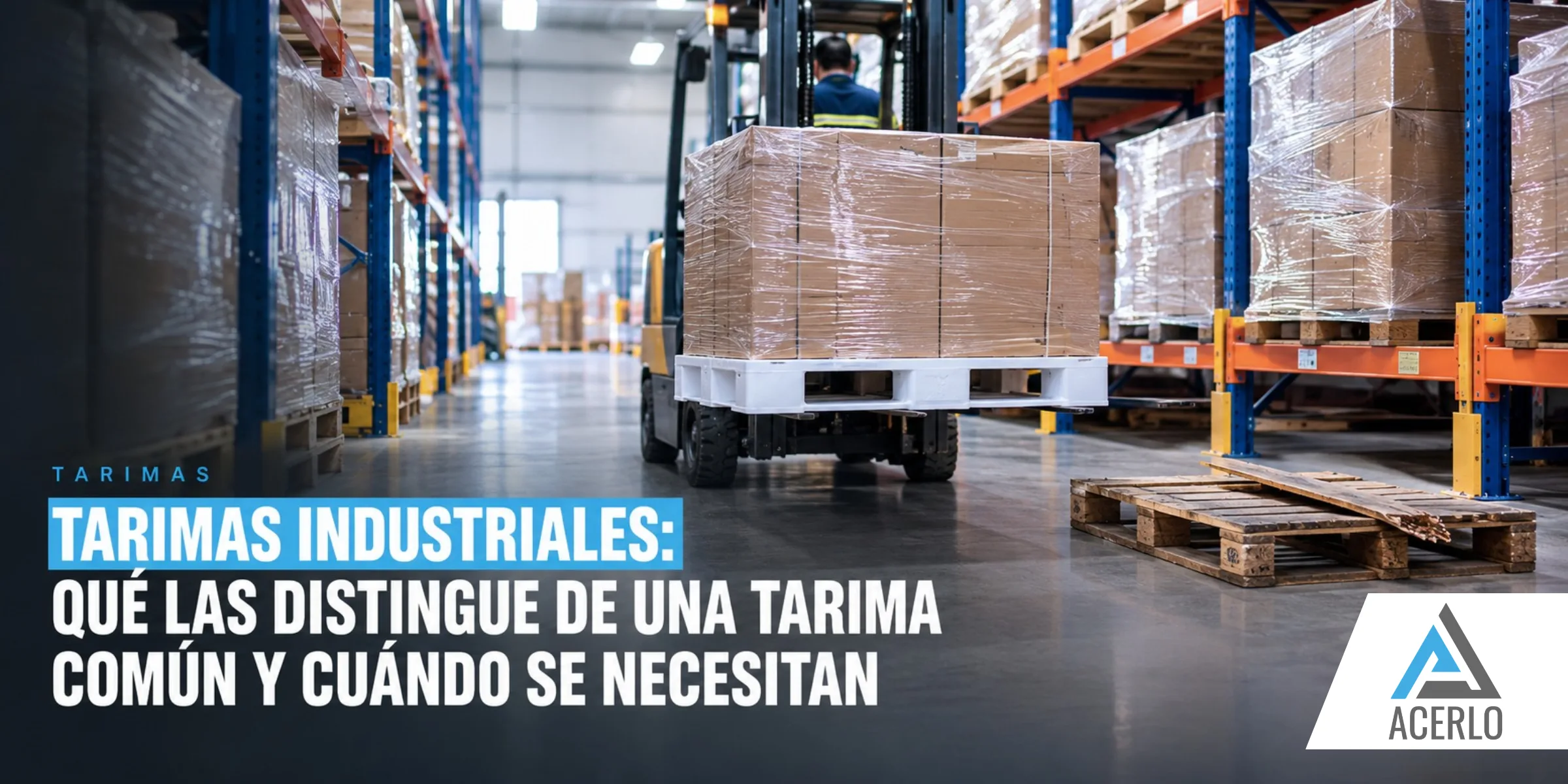
An auto parts plant in Salinas Victoria, near Monterrey, installs a four-level selective rack to free up floor space in its finished goods warehouse. To fill it, purchasing buys used wood pallets from a recycling yard, all 39.4 × 47.2 in (100 × 120 cm) according to the seller and at a good price per piece. They come from several sources: some with thick deck boards, others with thin, repaired boards, a few nearly an inch (2 cm) shorter than the rest.
In the second week, as it comes down from the third level, a loaded pallet drops a board from its base. The boxes slide off and fall into the aisle, and the safety team shuts down that bay for half a shift. The damaged parts go to inspection, the day's shipment leaves short and, at the next audit, the customer asks for the spec of the pallets in the rack. Nobody at the plant has one.
A pallet is the base on which loads are moved and stored in a plant. The types of pallets differ by material, entries, use and size. Purchase orders and audits bring up another distinction: an ordinary pallet versus an industrial pallet.
By ordinary pallet we mean one bought by the piece, with no data beyond an approximate size: secondhand, repaired, whatever was sitting in the supplier's yard. It does the job for stacking light loads on the floor inside your plant. An industrial pallet is designed and bought for a specific operation, with data you can write on a purchase order and verify when it arrives.
What sets an industrial pallet apart is its spec sheet. It lists the exact size and height, the static load, the dynamic load, the number of entries, the material and the weight of the empty pallet. With that data, purchasing, warehouse, quality and shipping talk about the same piece, and the supplier has something to answer to if a lot arrives different.
Our Stiropallet plastic pallet, for example, is specified like this: 39.4 × 47.2 × 5.3 in (100 × 120 × 13.5 cm) in its standard size, 9.9 lb (4.5 kg), up to 4,400 lb (2,000 kg) of static load and 1,760 lb (800 kg) of dynamic load, thermoformed from EPS at our plant in Santa Catarina. Each figure answers a question about your operation: whether it fits the rack, whether your equipment can lift it, whether it holds your load and how much it weighs in freight.
The ordinary pallet carries a less visible problem: two pieces from the same lot can be different. Used wood mixes species, board thicknesses, board counts and repairs, and each piece arrives with whatever moisture it picked up in the yard. That is why a 39.4 × 47.2 in (100 × 120 cm) wood pallet weighs 33 to 55 lb (15 to 25 kg), and a single shipment can carry pallets at both ends of that range.
You pay for that variation in the rack, which needs even edges; in the load plan, which is calculated with a fixed size; and on the scale, which records a weight different from the one declared. An industrial pallet reduces it from the moment you buy, because every lot is supplied against the same spec.
A pallet works in three ways during its life in the plant, and each one demands something different. The ordinary pallet usually survives the first and fails at the other two.
On the floor, the pallet spreads the weight over its whole base; that is the static load. When the forklift or the pallet jack lifts it, the weight rests on the forks and the pallet takes every start and every stop; that is the dynamic load, always lower than the static load. In a selective rack, the pallet rests only on its edges, with no floor underneath, and that condition demands more from its structure than stacking does.
The Stiropallet plastic pallet can be used in racks. Before it goes up, we review with you the weight of your loaded pallet and the type of rack, because the recommendation has to come from your operation. An ordinary pallet rarely comes with that data, and its first load test ends up being the one in Salinas Victoria.
The pallet's surface touches the product, the stretch wrap and your crew's hands. Used wood brings splinters, nails that stick out and loose boards that tear boxes, sacks and stretch film. Wood is porous: it absorbs water in the rainy season, gains weight and loses strength.
The Stiropallet plastic pallet has a smooth, hygienic, non-porous surface, with no splinters, nails or pests. It does not absorb moisture, keeps its weight in the rainy season and cleans easily, so it reaches your customer in the same condition it left your dock.
Before it takes any load, every pallet is placed and stacked, often by hand. Mexico's NOM-036-1-STPS-2018 standard requires workplaces to control the risks of manual load handling, and a 9.9 lb (4.5 kg) pallet takes less effort than one weighing 33 to 55 lb (15 to 25 kg).
An ordinary pallet can serve for years inside a plant. These are the situations where we see it fall short and the spec becomes mandatory.
When your warehouse grows upward, a weak board or a repaired stringer that held up on the floor gives way on the third level, where a fall hits product, equipment and people. In a rack, the pallet needs a known capacity and even edges from piece to piece.
Every wood pallet that crosses into the United States must comply with ISPM 15: heat treatment or fumigation and the IPPC stamp visible on the piece. A secondhand pallet with no stamp, or with an illegible one, can hold up the entire shipment. The Stiropallet plastic pallet complies with ISPM 15 with no treatment, no fumigation and no stamp, because those requirements apply only to wood.
Food, pharmaceutical and electronics plants often reject wood in their clean areas. There the pallet is part of sanitary control and has to be smooth, washable and non-porous. The Stiropallet plastic pallet is used in those industries, beverages included, and it suits plants that do not accept wood pallets.
When the pallet makes several trips between your plant and your customer's, every cycle knocks it, wets it and dirties it, and an ordinary pallet loses boards and nails on the way back. The Stiropallet plastic pallet is reusable, resists water and can be washed between cycles, and we pair it with returnable corrugated plastic dunnage that comes back to the production line along with it.
Many industrial customers review their suppliers' packaging as carefully as the part: they ask for the pallet's description, capacity and material in the packaging plan, and they expect every shipment to arrive like the last one. With an ordinary pallet there is nothing to write down; with an industrial one, the spec sheet already has the answer.
Moving from an ordinary pallet to an industrial one starts with a spec sheet. In 25 years of experience in the industry, we have seen that these fields are enough for your supplier, your warehouse and your customer to talk about the same pallet:
With the sheet written, receive the first lot with a tape measure and a scale: measure and weigh a few pallets at random, check the surface and test the entries with your forklift and your pallet jack. If everything matches, each following lot is received against the same data.
At ACERLO we quote from your product dimensions, your monthly quantity and the destination; a drawing or a photo of the load speeds up the quote. We manufacture the Stiropallet plastic pallet at our plant in Santa Catarina and deliver it to your plant in 3 to 5 days near Monterrey and in 5 to 10 days in the rest of Mexico and in the United States. If you also need corrugated plastic dunnage or woven polypropylene sacks, all your packaging is quoted together and arrives together.
An industrial pallet stands apart because of the data it carries in writing and meets lot after lot, and it becomes necessary the moment your load goes into a rack, crosses the border, enters a clean area or returns to your line. If you want to specify the pallets at your plant, send us your dimensions, your monthly volume and your destination, and at ACERLO we will reply with the proposal for your packaging.
Frequently Asked Questions
It can be wood or plastic. What defines it is its written spec: size, static and dynamic load, entries and material. For export, a wood pallet needs ISPM 15 treatment and stamp; the Stiropallet plastic pallet complies with the standard without that step.
Yes. It is rack-ready and holds up to 4,400 lb (2,000 kg) of static load and 1,760 lb (800 kg) of dynamic load in its standard 39.4 × 47.2 in (100 × 120 cm) size. Before it goes up, we review with you the weight of your loaded pallet and the type of rack.
When it stays inside your plant, carries light product stacked on the floor and no customer asks for its spec. As soon as the pallet goes into a rack, crosses the border, enters a clean area or returns to your line, it pays to specify it.
Keep Reading
Heat and EPS versus boards and nails. How the manufacturing process decides your pallet's weight, moisture, surface and paperwork at the border.
Read Article24 to 28 pallets of 39.4 × 47.2 in per level, depending on the pattern, and up to twice that double stacked. The math with width, height and weight.
Read ArticleTarima in Mexico, pallet in English, palet in Spain. The sizes and units each name carries and how to write the pallet on a purchase order.
Read ArticleWood or Stiropallet, two or four-way entry, one-way or returnable, 100 × 120 cm or 40 × 48 in. How to choose a pallet by the load.
Read ArticleA pallet turns loose boxes into one unit load a forklift moves at once. Its parts, its capacity and how to choose one.
Read ArticleRequest a Quote
Send us your dimensions, monthly volume, and destination, and we will reply with pricing.