A snack food plant in Guadalupe, near Monterrey, switches wood pallet suppliers because the new one quoted a lower price per piece. The first lot arrives after a week of rain, with boards of different thicknesses and the wood still damp, and it sits in the yard under an open shed. Nobody inspects it: the pallets are the right size, and that seems to be enough.
Three days later, the shipment reaches a grocery chain's distribution center. The receiving inspector finds a splinter between the boxes, a nail poking through the deck and moisture stains on the bottom cartons. The inspector rejects the entire shipment, the plant pays the return freight and repacks everything on an overtime shift. The problem started at the sawmill, long before anyone put a box on the pallet.
Two Manufacturing Processes That Arrive Differently at Your Dock
A thermoformed pallet and a wood pallet can have the same size and do the same job in your warehouse. What separates them starts at the plant where each one is made, and that difference travels with every pallet to your customer's dock. Here we look at how each one is made and what that changes in your operation.
Wood pallet: boards cut, nailed and, for export, treated
A wood pallet starts at the sawmill. The wood is cut into boards, stringers or blocks, and each piece is nailed onto the others to form the deck, the supports and the base. The result depends on the species, the thickness of each board, the number of nails and the moisture the wood had when it was assembled. That is why a 39.4 × 47.2 in (100 × 120 cm) wood pallet weighs 33 to 55 lb (15 to 25 kg), and two pallets from the same supplier can land at opposite ends of that range.
If the pallet will cross into the United States, the process adds a step: ISPM 15 requires heat treatment or fumigation and the IPPC stamp visible on the piece. That step adds to the cost, to the supplier's lead times and to the paperwork you have to keep for every lot.
Thermoformed pallet: EPS takes the shape of the pallet with heat
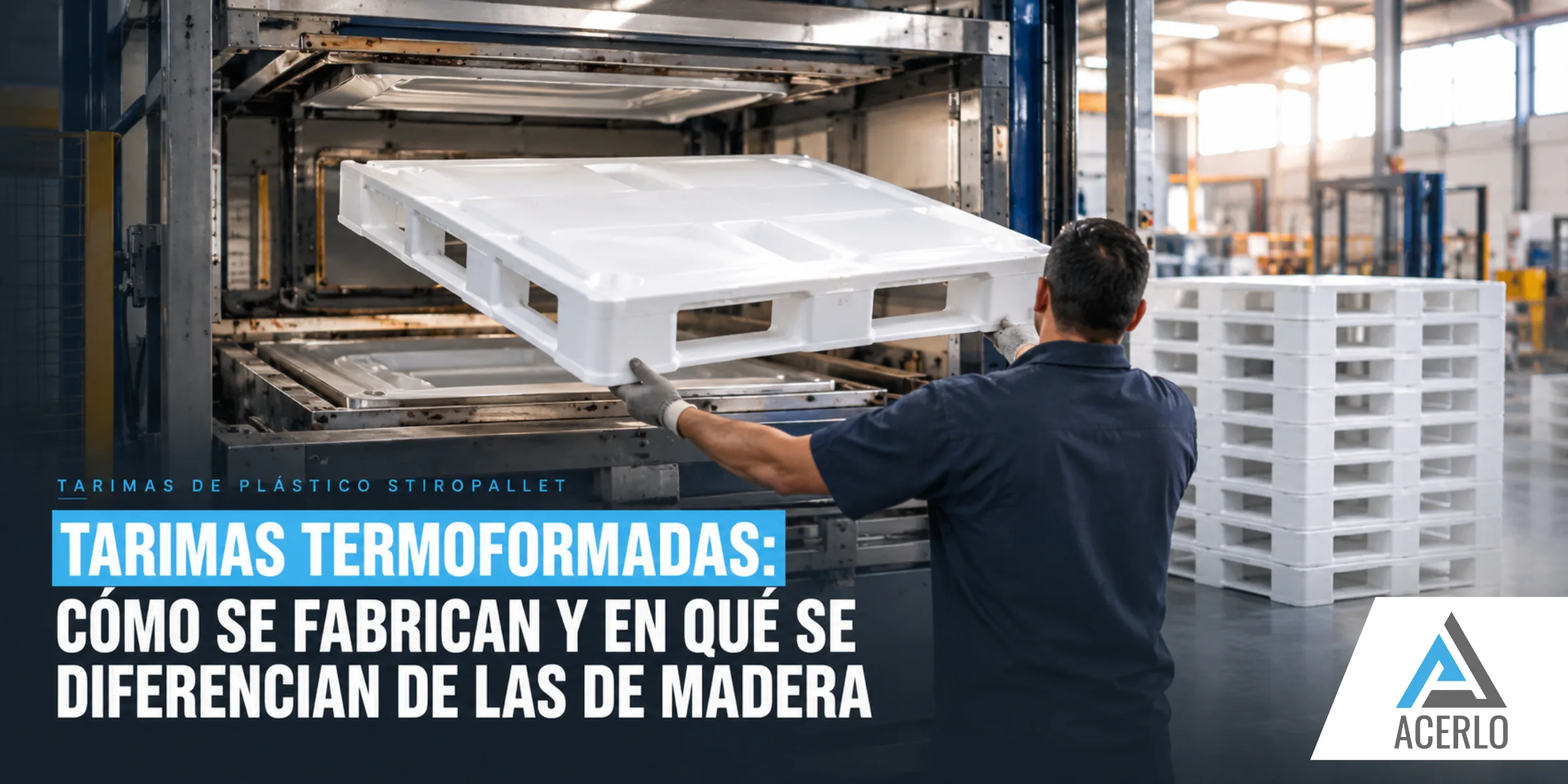
Thermoforming shapes a plastic material with heat. At our plant in Santa Catarina we thermoform the Stiropallet plastic pallet from EPS: the material goes into the thermoforming machine and comes out in the shape of the pallet, with its deck, its supports and its entries. There are no boards to cut and no nails to drive.
We control the process parameters at the plant. What matters to you as a buyer is what it delivers: a 39.4 × 47.2 × 5.3 in (100 × 120 × 13.5 cm) pallet in its standard size, weighing 9.9 lb (4.5 kg), with up to 4,400 lb (2,000 kg) of static load and 1,760 lb (800 kg) of dynamic load. Because the shape comes out of the thermoforming machine and not from piece-by-piece assembly, the pallets in a lot share the same shape and size, without the differences in species, thickness and moisture that wood brings.
What the Manufacturing Process Decides Before the Pallet Takes Any Load
Each process leaves its mark on the finished pallet. These are the four differences we see most often at the plants we serve.
Joints and nails: the weak point of an assembled pallet
In a wood pallet, strength depends on the joints. Every bump from the forklift, every time the truck brakes and every off-center load works on the nails, which over time loosen, bend or start to stick out of the deck. A protruding nail tears the stretch wrap, punctures boxes and sacks, and at a food or pharmaceutical plant it is enough to stop receiving.
The Stiropallet plastic pallet is formed with no nails or boards, so it has no joints to loosen with handling. Its full capacity is stated on the spec sheet: 4,400 lb (2,000 kg) of static load and 1,760 lb (800 kg) of dynamic load in the standard size. For your quality team, that removes one checkpoint from every receiving inspection.
Porosity: moisture gets into wood and stays out of EPS
Wood is porous. Stored outdoors or in a warehouse without humidity control, it absorbs water, gains weight and loses strength, and the moisture encourages mold. That is what happened to the lot in the opening: the pallets were the right size and carried the last rain inside their boards.
The Stiropallet plastic pallet does not absorb moisture. It keeps its weight in the rainy season and resists water, so the weight you declare on the shipping documents matches what the scale reads in any month of the year.
Surface: splinters versus a smooth, washable deck
A wood deck is made of separate boards, with edges that splinter with use and gaps where dust and debris collect. Food, pharmaceutical and electronics plants often reject it in their clean areas because of the splinters, nails and pests it can bring in.
A thermoformed pallet has a smooth, hygienic, non-porous surface, with no splinters, nails or pests, and it cleans easily. That is why the Stiropallet plastic pallet is used in those industries and suits plants that do not accept wood pallets. In a receiving audit, the pallet surface stops being a reason for rejection.
Weight: 9.9 lb (4.5 kg) versus 33 to 55 lb (15 to 25 kg)
The process also sets the weight. The Stiropallet plastic pallet weighs 9.9 lb (4.5 kg) in the standard size, and a wood pallet of the same size, 33 to 55 lb (15 to 25 kg). That weight gets lifted every time someone places an empty pallet, and it travels on every shipment. In air freight, where cost is calculated by weight, less weight means less freight; on our site you will find a freight savings calculator to compare wood against the Stiropallet with your own numbers.
Export: Why the Pallet Material Decides the Paperwork at the Border
ISPM 15 is the international standard that regulates wood packaging in foreign trade. Its goal is to keep pests from traveling inside wood from one country to another, which is why the requirement falls on the pallet material.
Treatment and stamp: the step only wood requires
A wood pallet needs heat treatment or fumigation and the IPPC stamp to cross, and without them customs can send the entire shipment back. The Stiropallet plastic pallet complies with ISPM 15 with no treatment, no fumigation and no stamp, because those requirements apply only to wood, and it crosses the border with no phytosanitary paperwork. For your import and export team, changing the pallet material removes a document from every shipment.
The Wear Each Process Leaves on the Pallet in Daily Use
Wood: every repair changes the pallet
A wood pallet is repaired with new boards or extra nails, and that convenience has a less visible cost. Each repair adds wood of a different thickness, species or moisture, and the pallet stops resembling the one you bought. After several repairs, the lot that entered your warehouse uniform becomes a mix of different pieces, with weights and strengths nobody knows.
Thermoformed: washed with water and ready for many trips
The Stiropallet plastic pallet is reusable, resists water and can be washed between trips. In a returnable loop between your plant and your customer's, we pair it with returnable corrugated plastic dunnage that comes back to the production line along with it. It is also rack-ready and suited for beverages; before it goes into a rack, we review with you the weight of your loaded pallet and the type of rack.
What to Check When a Lot of Pallets Arrives, Based on How It Was Made
The rejected shipment in the opening would have been stopped in the yard with a receiving inspection. These are the points we recommend for each type of pallet:
- Wood: visible moisture, broken boards or boards of different thicknesses, nails that stick out and splinters on the deck.
- Wood for export: a legible IPPC stamp on every piece.
- Wood: the weight of a few pallets taken at random, to know where in the 33 to 55 lb (15 to 25 kg) range the lot arrived.
- Thermoformed: size and height against the spec sheet, and a clean surface with no damage.
- Both: entries that take your forklift and your pallet jack, and a loaded pallet weight that stays within its dynamic load.
With 25 years of experience in the industry, at ACERLO we quote from your product dimensions, your monthly quantity and the destination; a drawing or a photo of the load speeds up the quote, and the formal proposal with price and lead time reaches you by email. We thermoform the Stiropallet plastic pallet at our plant in Santa Catarina and deliver it to your plant in 3 to 5 days near Monterrey and in 5 to 10 days in the rest of Mexico and in the United States.
A thermoformed pallet and a wood pallet can measure the same, and the process used to make each one decides how much they weigh, how they respond to moisture, how clean their surface arrives and what paperwork they need at the border. If you want to compare the two with your plant's load, send us your dimensions, your monthly volume and your destination, and at ACERLO we will reply with the proposal for your packaging.