Pallets
Thermoformed Pallets: How They Are Made and How They Differ From Wood Pallets
Heat and EPS versus boards and nails. How the manufacturing process decides your pallet's weight, moisture, surface and paperwork at the border.
Read Article
BlogPallets
Tarima, pallet and palet name the same platform: tarima in Mexico, pallet in English, palet in Spain. Knowing which one to use helps you search, read quotes from other countries and write purchase orders with no ambiguity.
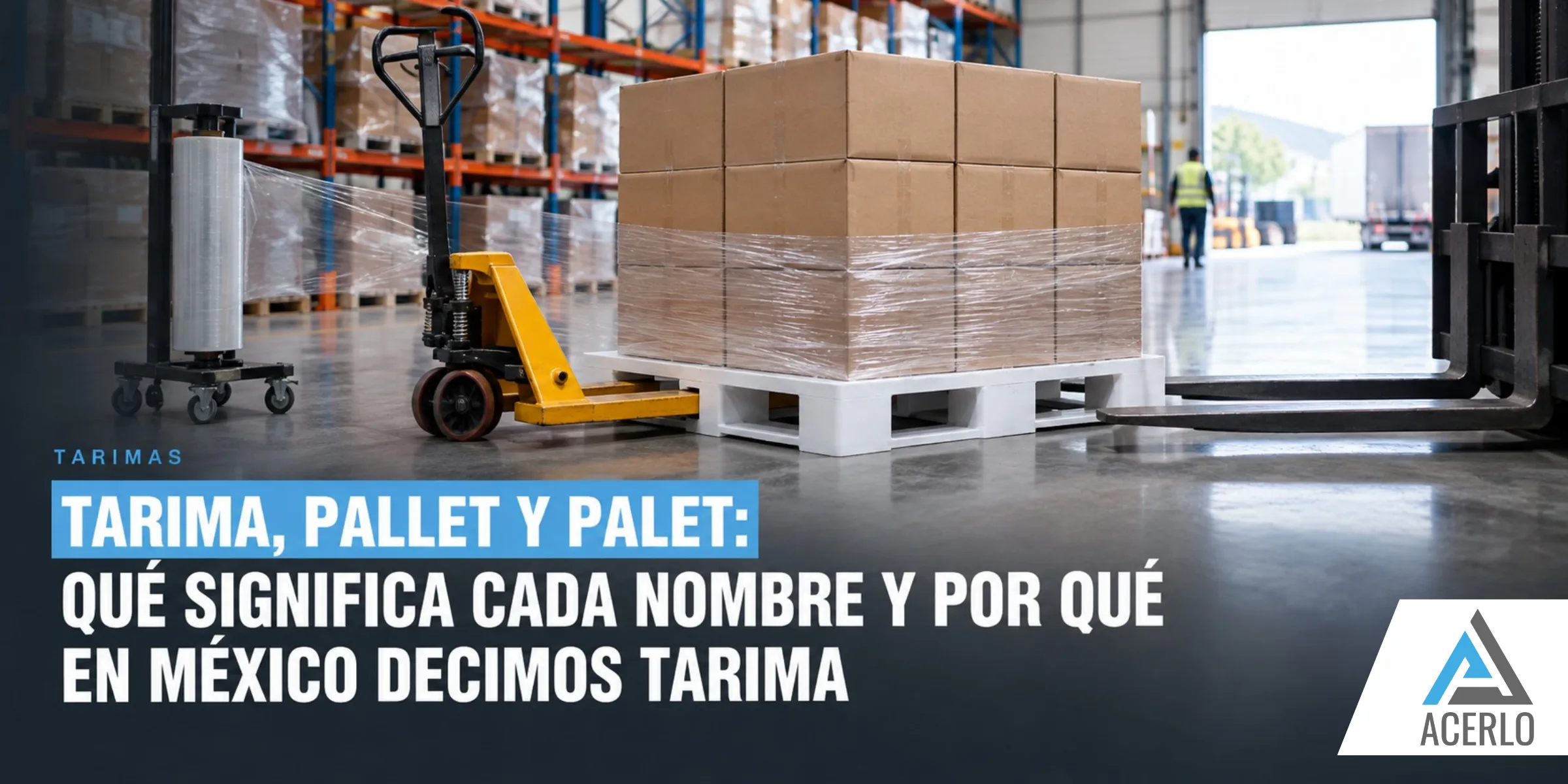
An HVAC components plant in Escobedo, near Monterrey, lands its first purchase order from a distribution center in Dallas. The order is in English and asks for the product “on 48 x 40 pallets, four-way entry.” The buyer reads it in a hurry, assumes pallet and tarima mean the same thing and asks the usual supplier for a full lot of standard tarimas. What arrives are 39.4 × 47.2 in (100 × 120 cm) two-way pallets, the same ones the plant has used for years with its domestic customers.
The first trailer reaches the Dallas dock and the receiving supervisor marks the delivery as nonconforming: the pallets are not the size on the order, and their entries only take a pallet jack from two sides, when that operation moves everything from all four. The product is restacked onto new pallets in a Laredo yard, the trailer racks up detention charges and the rest of the lot stays in Escobedo with no customer to take it. The whole cost came from a word nobody translated in full: behind “pallet” came a spec sheet.
Tarima, pallet and palet name the same piece: a platform with clearance underneath for the forks of a forklift or the wheels of a hand pallet jack. The role of a pallet in a plant and the types of pallets by material, entries, use and size stay the same whatever the name. Here we look at something else: what changes when the name travels from one country to another.
Each name carries the size, the units and the vocabulary of the place where it is used, and errors like the one in Escobedo start in that part nobody translates.
In Mexico we say tarima. That is how it appears on plant purchase orders, in shipping yards and in the daily conversation between warehouse, purchasing and logistics. In Spanish the word has broader uses: it also names a raised wooden platform, like the one in a hall or on a stage. In Mexican industry it became tied to the base a forklift lifts, and almost always to the 39.4 × 47.2 in (100 × 120 cm) size, the most used in the country. So when a supplier in Mexico quotes you a tarima, it is quoting a pallet, most likely in that size.
Pallet is the English name, and it is the one you read on any document from a U.S. customer or supplier: purchase orders, packaging specifications, bills of lading and spec sheets. It is also widely used in Mexico, especially in plants that work with foreign corporations, so it lives alongside tarima in the same warehouse and sometimes on the same purchase order.
Next to pallet, some specifications use skid. Strictly speaking it usually means a platform with no bottom deck, resting only on its runners, although many people use it as a synonym for pallet. If you see it on a purchase order, ask your customer what it expects to receive before you quote.
In Spain it is palet or palé. There, tarima usually means something else, such as a raised platform or a type of wood flooring, so a search for tarimas on Spanish sites can take you to flooring for homes. If you receive a quote from Spain, you will read palet, paletizar and palet europeo, the euro pallet, which measures 31.5 × 47.2 in (80 × 120 cm).
In Colombia the pallet is commonly called estiba, a word we use in Mexico for how the load is arranged, as in doble estiba, double stacking. The same word names the base in one country and the way to stack it in another. That is why, when you work with suppliers or customers in several countries, it pays to write the full description of the piece and leave the name in second place.
Search for tarima and you will usually find manufacturers and distributors in Mexico, with sizes in centimeters and delivery within the country. Search for pallet and U.S. suppliers, spec sheets in English and prices in dollars get mixed in; palet brings in results from Spain. All three names are valid, and it is worth knowing which market answers to each one. For a plant in northern Mexico, or a U.S. company sourcing packaging there, the practical move is to search with both tarima and pallet and compare only the suppliers that deliver to your plant on your timelines.
A quote from a U.S. supplier, or the specification from your U.S. customer, describes the pallet in its own units. The size is in inches, and the most common is 48 × 40, equal to 121.9 × 101.6 cm: close to 3/4 in (2 cm) more per side than the 39.4 × 47.2 in (100 × 120 cm) tarima. It looks like a small difference until the customer's racks or automated line are set to that size.
The load is in pounds, and one kilogram equals about 2.2 lb. So 800 kg is about 1,764 lb and 2,000 kg about 4,409 lb. If someone on your team reads a rating in pounds as if it were kilograms, they buy a pallet with less than half the capacity they think it has.
Spec sheets in English also name entries and loads with their own terms. Two-way entry is a tarima de dos entradas, and four-way entry, one with four. Static load is the carga estática, the weight the pallet holds resting on the floor; dynamic load is the carga dinámica, the weight it holds while the forklift moves it; racking load is the weight it holds in a rack, supported only on its stringers. They are the same concepts we use in Mexico under another name, and translating them correctly on the purchase order prevents the rejected shipment from the opening.
Our Stiropallet plastic pallet measures 39.4 × 47.2 × 5.3 in (100 × 120 × 13.5 cm) in its standard size and weighs 9.9 lb (4.5 kg). It holds up to 4,409 lb (2,000 kg) of static load and 1,764 lb (800 kg) of dynamic load. When your U.S. customer asks for the pallet data, it pays to give it in both units so its receiving team does not have to convert anything.
The verbs and equipment that go with the pallet also change names from country to country. These are the ones we see most often on purchase orders and packing instructions.
Paletizar means arranging product on the pallet to form a unit load, that is, to palletize; you will also see it spelled palletizar, with a double l, under the influence of English. Emplayar means wrapping that load in stretch film so it travels as one block. It is the term we use in Mexico, and on a U.S. specification it appears as stretch wrap. If your customer's instructions call for stretch wrap with a set number of turns, they are talking about the emplaye.
In Mexico, the patín hidráulico is the manual equipment that lifts the pallet a few inches to pull it across the floor; in English it is a pallet jack and in Spain, a transpaleta. The montacargas is a forklift in English and a carretilla elevadora in Spain. The uñas, also called horquillas, are the forks that go into the openings of the pallet. Knowing these names helps you read the manual of imported equipment and understand which entries the pallet needs so your customer's equipment can lift it.
In Mexico, estibar means arranging the load, and doble estiba means placing one loaded pallet on top of another, what U.S. shippers call double stacking. In freight quotes in English, space is counted in pallet positions, each spot on the trailer floor that one pallet takes up. When your carrier quotes per position, the pallet size decides how many positions fit and how much you pay for each one.
The rejected shipment from the opening would have been avoided with a purchase order that said the same thing in both languages. In 25 years of experience in the industry, we have seen that these details are enough for your supplier, your customer and your carrier to talk about the same pallet:
At ACERLO we quote from your product dimensions, your monthly quantity and the destination; a drawing or a photo of the load speeds up the proposal, which we send you by email with price and lead time. We manufacture the Stiropallet plastic pallet at our plant in Santa Catarina, and because ISPM 15 applies only to wood, it crosses into the United States with no treatment, no stamp and no phytosanitary paperwork. If your customer asks for 48 × 40 in, we review it with you from the quote stage. We deliver in 3 to 5 days near Monterrey and in 5 to 10 days in the rest of Mexico and in the United States.
Tarima, pallet and palet name the same base, and what separates an accepted shipment from a rejected one is the spec that travels with each word. If your next shipment goes to a customer who writes in English, send us your dimensions, your monthly volume and your destination, and at ACERLO we will reply with the proposal for your packaging.
Frequently Asked Questions
Yes. Tarima is the name we use in Mexico and pallet is the English word for the same load platform; in Spain it is palet or palé. What changes from country to country are the sizes and the units used to describe it.
About 39.4 × 47.2 in. The most common pallet in the United States measures 48 × 40 in, or 121.9 × 101.6 cm, close to 3/4 in (2 cm) more per side. Confirm with your customer which one its dock accepts before you quote.
Divide the pounds by 2.2. A dynamic load of 2,000 lb equals about 907 kg. The Stiropallet plastic pallet holds 1,764 lb (800 kg) of dynamic load and up to 4,409 lb (2,000 kg) of static load.
Keep Reading
Heat and EPS versus boards and nails. How the manufacturing process decides your pallet's weight, moisture, surface and paperwork at the border.
Read ArticleAn industrial pallet is bought with a spec sheet. The data it carries and when you need it: racking, export, clean areas, returnable packaging and audits.
Read Article24 to 28 pallets of 39.4 × 47.2 in per level, depending on the pattern, and up to twice that double stacked. The math with width, height and weight.
Read ArticleWood or Stiropallet, two or four-way entry, one-way or returnable, 100 × 120 cm or 40 × 48 in. How to choose a pallet by the load.
Read ArticleA pallet turns loose boxes into one unit load a forklift moves at once. Its parts, its capacity and how to choose one.
Read ArticleRequest a Quote
Send us your dimensions, monthly volume, and destination, and we will reply with pricing.