Pallets
Thermoformed Pallets: How They Are Made and How They Differ From Wood Pallets
Heat and EPS versus boards and nails. How the manufacturing process decides your pallet's weight, moisture, surface and paperwork at the border.
Read Article
BlogPallets
Pallets are classified by material, by entries, by use and by size. To choose the right one, start from what you are moving: weight per pallet, destination, customer requirements and how many trips it will make.
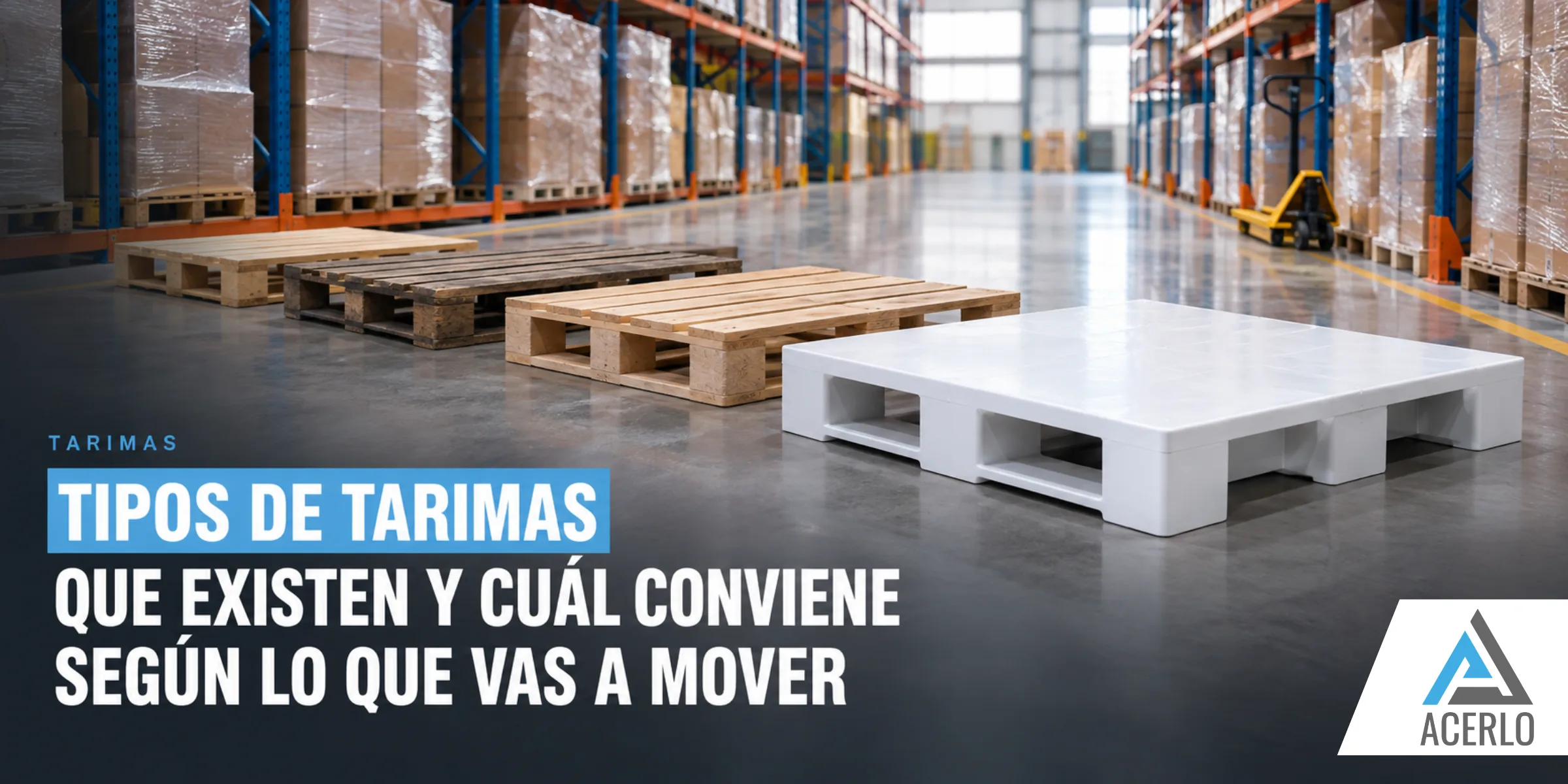
An auto parts plant in Ramos Arizpe lands its first contract with an assembly plant in Texas and buys 500 used wood pallets because they were the cheapest ones in the yard. The first shipment leaves on a Tuesday. On Thursday, the customs broker reports that the load is being held at the border: the pallets carry no treatment stamp, which the United States requires on wood, and the choice is to repack everything in Nuevo Laredo or send the truck back.
Two days of repacking, a trailer sitting idle and a late first delivery to the most important customer of the year. Meanwhile, at the same plant, a lot for a food packer comes back rejected because of splinters on the pallet decks. The 500 pallets were all identical; the loads they had to carry were not.
Material is the first division among pallet types and the one with the most consequences in a plant, because it sets the weight, hygiene, moisture resistance and export paperwork. In Mexico two types dominate: wood and plastic.
The wood pallet is the one you find in most yards. It is built from boards nailed to stringers or blocks, it is easy to repair and it comes in every size. In the 39.4 × 47.2 in (100 × 120 cm) size it weighs 33 to 55 lb (15 to 25 kg), depending on the species, the number of boards and how much moisture it carries. Wood is porous: it absorbs water in the rainy season, gains weight and loses strength; with use it sheds splinters and the nails start to stick out.
To cross into the United States, the international ISPM 15 standard requires every wood pallet to carry heat treatment or fumigation and a visible IPPC stamp. That is the requirement that stopped the Ramos Arizpe shipment. In food, pharmaceutical and electronics plants, wood is also usually kept out of clean areas because of the splinters and pests it can carry.
The Stiropallet we manufacture in Santa Catarina is thermoformed from EPS in a single piece: a smooth surface with no boards, no nails and no joints. In the standard 39.4 × 47.2 × 5.3 in (100 × 120 × 13.5 cm) size it weighs 9.9 lb (4.5 kg) and supports up to 4,400 lb (2,000 kg) of static load and 1,760 lb (800 kg) of dynamic load. It does not absorb moisture, so it weighs the same in January as in September; it resists water and cleans easily.
Because ISPM 15 applies only to wood, the Stiropallet crosses the border with no treatment, no stamp and no phytosanitary paperwork. Thanks to its non-porous surface, it is used by food, pharmaceutical and electronics plants that do not accept wood, and in air freight, where cost is calculated per pound, its 9.9 lb show up on every shipment.
There are also metal pallets, for very heavy loads or extreme temperatures, and cardboard or pressed-fiber pallets, meant for light, one-way loads. They are solutions for specific cases; in the daily operation of an industrial plant in northern Mexico, the real decision is between wood and plastic.
The second way to classify a pallet looks at how it is lifted. It seems like a design detail, but it decides whether your floor crew can move it or not.
A two-way pallet accepts the forklift's forks on only two of its sides; a four-way pallet accepts them on all four. In a tight dock, or when the pallet ends up turned inside the truck, the four-way pallet avoids maneuvering and impacts. If your operation uses hand pallet jacks, also check that the jack's wheels pass through the base: not every pallet allows it, and a jack that does not fit forces you to move the load with a forklift even when it weighs very little.
A single-face pallet has a deck only on top; a double-face pallet has boards on top and bottom, which spreads the weight better on the floor and allows loaded pallets to be stacked on each other. The double-face pallet weighs more, and in wood that extra weight is paid on every freight bill. Ask your customer how they store: if they stack on the floor, the base of the pallet matters as much as the deck.
The third division answers how many times the pallet will travel and under what conditions. This is where the most money is lost when a single pallet is bought for everything.
In export, the pallet usually stays with the customer. What counts is the cost per trip: the weight you pay in freight, the paperwork wood drags through the border and the risk of rejection at the dock. A light, clean pallet that is exempt from ISPM 15 reduces all three.
Between plants of the same group, or between your plant and a nearby supplier, the pallet makes several round trips. Here it matters that it withstands repeated handling without shedding pieces and that it can be washed between cycles. The Stiropallet is reusable and its surface cleans with water, which lets you build it into a returnable packaging system together with corrugated plastic dunnage and crates with dividers.
In a selective rack, the pallet works supported only at its edges, with no floor underneath. That condition demands more from the structure than floor stacking. The Stiropallet can be used on racks; before putting it up, we review with you the weight of your loaded pallet and the type of rack, so the recommendation comes out of the quote and not out of a trial in your warehouse.
Size is the fourth division and the one that defines how many pallets fit in a trailer and whether the customer's rack receives them. In Mexico the most common size is 39.4 × 47.2 in (100 × 120 cm), which is the standard Stiropallet footprint. In the United States the 40 × 48 in pallet dominates, and many distribution centers require it because their racks and automated lines are set up for it. In Europe the reference is the 31.5 × 47.2 in (80 × 120 cm) Euro pallet.
The number of pallets per truck and their arrangement come from the load plan you build with your carrier, and they change with the size, the load height and the weight per pallet. What you need to define at the plant is that the pallet size, the box pattern on it and the stretch wrap form a single unit load design, approved by the customer before the first shipment.
With the four classifications in hand, the choice comes down to answering four questions about your load. The same ones we ask at ACERLO before we quote.
With the answers, the pallet type almost chooses itself. Heavy loads stacked on the floor inside your plant: wood does the job, as long as you inspect it. Export to the United States, air freight or a food, pharmaceutical or electronics customer: the Stiropallet, for weight, hygiene and the absence of paperwork. Returnable packaging between plants: the Stiropallet with corrugated plastic dunnage cut to your part, so the whole system comes back to the line.
To get a quote, send us the dimensions of your product or part, your monthly quantity and the destination; a drawing or a photo of the load speeds up the proposal. We manufacture Stiropallet plastic pallets at our plant in Santa Catarina and deliver in 3 to 5 days near Monterrey, and in 5 to 10 days in the rest of Mexico and in the United States.
Pallet types exist because loads are different: weight, destination, the customer receiving it and the number of trips decide which one makes sense. If you want to review which pallet each shipment from your plant needs, send us your dimensions, your monthly volume and your destination, and at ACERLO we will reply with the proposal for your packaging.
Frequently Asked Questions
One that complies with ISPM 15 or falls outside it. Wood needs heat treatment or fumigation and the IPPC stamp; the Stiropallet crosses with no treatment, no stamp and no phytosanitary paperwork, and it weighs 9.9 lb.
Usually one with a smooth, non-porous, washable surface, with no splinters or nails. The Stiropallet is used in food, pharmaceutical and electronics plants for that reason.
You can, but you overpay somewhere: paperwork and weight in export, rejections at customers with hygiene requirements, or pallets that do not survive the return trip. It pays to choose by load type and destination, even if that means two or three different pallets in the yard.
Keep Reading
Heat and EPS versus boards and nails. How the manufacturing process decides your pallet's weight, moisture, surface and paperwork at the border.
Read ArticleAn industrial pallet is bought with a spec sheet. The data it carries and when you need it: racking, export, clean areas, returnable packaging and audits.
Read Article24 to 28 pallets of 39.4 × 47.2 in per level, depending on the pattern, and up to twice that double stacked. The math with width, height and weight.
Read ArticleTarima in Mexico, pallet in English, palet in Spain. The sizes and units each name carries and how to write the pallet on a purchase order.
Read ArticleA pallet turns loose boxes into one unit load a forklift moves at once. Its parts, its capacity and how to choose one.
Read ArticleRequest a Quote
Send us your dimensions, monthly volume, and destination, and we will reply with pricing.