Pallets
Packaging Pallets: How to Choose the Right Pallet for the Product on Top
Weight, support, base, surface and destination. The five product facts that decide the size, load rating and material of your packaging pallet.
Read Article
BlogPallets
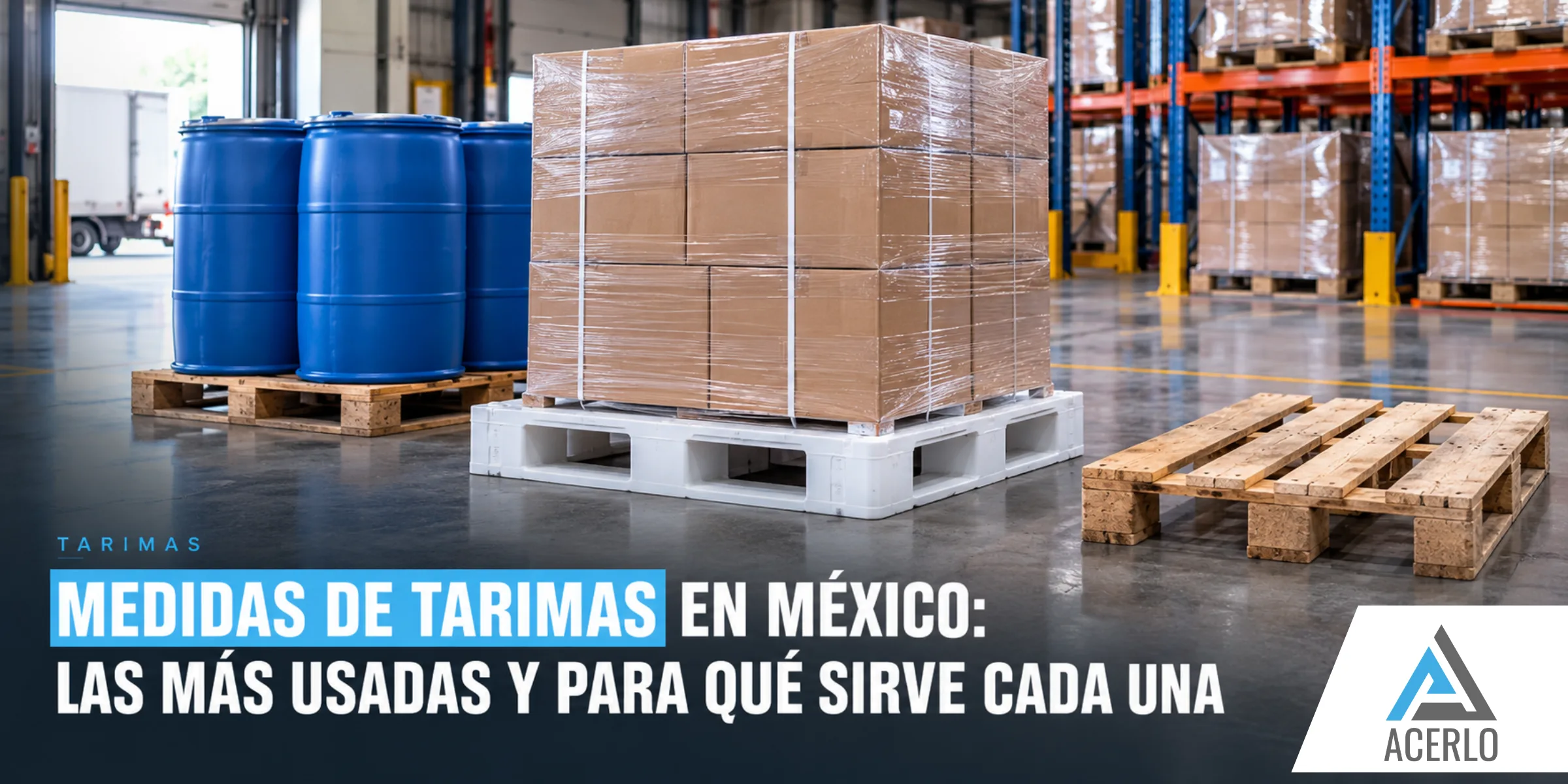
In Mexico the most common size is 39.4 × 47.2 in (1.00 × 1.20 m). For the United States, 48 × 40 in; for Europe, 47.2 × 31.5 in (1.20 × 0.80 m); for drums, 47.2 × 47.2 in (1.20 × 1.20 m). Choose by your product and your destination.
A beverage concentrate plant in Apodaca, near Monterrey, signs a contract with a bottler in the Bajío region and prepares the first shipment: 53-gallon (200 L) plastic drums, four per pallet. It uses the 39.4 × 47.2 in (100 × 120 cm) pallets it keeps in the warehouse for its boxes, because purchasing ordered them as “standard pallets.” Four drums in a square need about 47.2 in (1.20 m) per side, so they overhang the 39.4 in (1.00 m) side by a few inches.
In the truck, the overhanging edges hit those of the neighboring pallet at every stop. Around San Luis Potosí, a drum cracks at the rim and the concentrate runs over three more pallets. The bottler rejects the entire shipment over contamination risk, and the plant pays the return freight, the trailer cleanup and the lost product. The 47.2 × 47.2 in (1.20 × 1.20 m) square pallet, the size used for drums, was never considered.
On a purchase order, “standard pallet” means whatever the reader understands. For a plant in northern Mexico it is the 39.4 × 47.2 in (100 × 120 cm) pallet. For a buyer at a U.S. company it is the 48 × 40 in pallet, and for a European customer it is the euro pallet, 47.2 × 31.5 in (120 × 80 cm). The three look alike on paper and behave differently in a rack, on an automated line and in a trailer.
Each region of the world works with its own reference size. The ISO 6780 standard recognizes six pallet sizes for international transport, and each market adopted one or two. In this article we give an overview of the ones most used in Mexico and the job each one does. The size also defines how many pallets fit in a trailer.
A pallet size has three figures: length, width and height. When only two numbers are written, make clear which one is the length and which side the forklift forks enter, because on a two-way pallet, 39.4 × 47.2 and 47.2 × 39.4 change the way it is lifted. Height counts too: it adds inches to every pallet in the stack and defines how much product fits under the roof of the trailer or the rack. Our Stiropallet plastic pallet, for example, measures 39.4 × 47.2 × 5.3 in (100 × 120 × 13.5 cm).
These are the sizes we find most often in plants, warehouses and docks across Mexico, and the reason each one is still in use.
The 39.4 × 47.2 in (1.00 × 1.20 m) pallet is the most common in Mexico. You find it in warehouses, production lines, selective racks and domestic distribution centers, and most suppliers have it available. It works well for corrugated boxes, sacks and finished goods that stay in the country or go to customers who work with the same size.
It is also the standard size of our Stiropallet plastic pallet: 39.4 × 47.2 × 5.3 in (100 × 120 × 13.5 cm), 9.9 lb (4.5 kg), up to 4,400 lb (2,000 kg) of static load and 1,760 lb (800 kg) of dynamic load. Our industrial crates with dividers have a 47.2 × 39.4 in (1200 × 1000 mm) base, the same footprint, so pallet and crate form a single unit load.
The 48 × 40 in pallet, about 121.9 × 101.6 cm, is the most common in the United States. Many distribution centers there set their racks, conveyors and automated lines to that size, and write it as a requirement on the purchase order. In Monterrey, Ramos Arizpe and the border region, plants that supply U.S. companies find it in their packaging specs.
The difference from the 39.4 × 47.2 in (100 × 120 cm) pallet is about 0.8 in (2 cm) per side. On paper it looks small; on an automated line with tight guides or in a rack built to an exact size, it can lead to a nonconforming delivery. If your customer asks for 48 × 40, ask whether it accepts 39.4 × 47.2 in (100 × 120 cm) before shipping and keep the answer in writing. If the pallet is wood, it also needs ISPM 15 treatment and stamp to cross the border.
The euro pallet measures 47.2 × 31.5 in (120 × 80 cm) and is the reference in Europe. In Mexico it is used mainly by plants that export to that continent or that work to packaging specs from European groups. Its 31.5 in (80 cm) width makes it useful for light loads or narrow bases, and for aisles and racks designed to that depth.
The 47.2 × 47.2 in (1.20 × 1.20 m) square pallet, close to 48 × 48 in, is used mainly for round loads. Four 53-gallon (200 L) drums fit in a square without overhanging the deck, and each drum is fully supported. It was the size missing in the Apodaca case: with it, the drums would have traveled inside the edge of the pallet.
The half pallet, 23.6 × 31.5 in (60 × 80 cm), serves small loads, retail floor displays and orders that do not fill a full pallet. It moves with a pallet jack in narrow aisles and takes up half a euro pallet position.
When the product exceeds every common size, because of its length, shape or weight, a custom pallet is designed. In that case, the size comes from the base of the product and from what your customer's rack and transport accept, and it pays to write it into the packaging spec so every lot arrives the same.
The wrong size is discovered far from the warehouse: in the truck, in the rack or at the customer's dock. These are the three signs we see most.
If the load goes past the edge of the pallet, that edge takes the hits from the forklift, the neighboring pallet and the trailer walls. The bottom boxes lose support at their corners, which is where they are strongest, and get crushed under the weight of the stack. With round loads, like the drums in Apodaca, the overhanging rim is the first to get hit.
If the pallet is larger than the load, every position in the truck carries empty space and the load sits loose inside the stretch wrap. With each stop, the boxes slide toward the edge and the stack loses its shape. Matching the pallet size to the box pattern recovers space on the trip and keeps the load tight.
A selective rack has a depth and a beam spacing designed for one size. A smaller pallet can end up poorly supported, and a larger one can be left out. Automated lines and conveyors have guides and sensors set to one size, and they stop or divert any pallet that does not match. Before you change sizes, confirm with your customer how it stores and how it receives.
In 25 years of experience in the industry, we have seen that the right size gets defined at the desk, before the purchase order. This is the review we recommend for a new product or customer:
With that data, purchasing orders the right size the first time, the warehouse knows how to receive it and shipping builds the load plan with no surprises at the dock.
At ACERLO we manufacture the Stiropallet plastic pallet in Santa Catarina in a standard size of 39.4 × 47.2 × 5.3 in (100 × 120 × 13.5 cm). It complies with ISPM 15 with no treatment, no fumigation and no stamp, because those requirements apply only to wood, and it is rack-ready. To get a quote, send us your product dimensions, your monthly quantity and the destination; if your customer asks for another size, include it in the request. We deliver to your plant in 3 to 5 days near Monterrey and in 5 to 10 days in the rest of Mexico and in the United States. If you also need corrugated plastic dunnage or woven polypropylene sacks, all your packaging is quoted together and arrives together.
Each pallet size in Mexico answers a different job: 39.4 × 47.2 in (1.00 × 1.20 m) for domestic operations, 48 × 40 in for the United States, 47.2 × 31.5 in (1.20 × 0.80 m) for Europe and the square pallet for drums. If you want to confirm the size for your next shipment, send us your dimensions, your monthly volume and your destination through https://acerlo.com.mx/en/plastic-pallets/, and at ACERLO we will reply with the proposal for your packaging.
Frequently Asked Questions
The 39.4 × 47.2 in (1.00 × 1.20 m) pallet. You find it in most warehouses, racks and distribution centers in the country, and it is the standard size of our Stiropallet plastic pallet.
It depends on its operation. If its rack or automated line is set to 48 × 40 in, it may flag the delivery as nonconforming. Ask before the first shipment and keep the answer in writing.
For round loads, such as 53-gallon (200 L) drums, which in a square need about 47.2 in (1.20 m) per side. On a 39.4 × 47.2 in (100 × 120 cm) pallet, those drums overhang the short side and get hit during the trip.
Keep Reading
Weight, support, base, surface and destination. The five product facts that decide the size, load rating and material of your packaging pallet.
Read ArticleHeat and EPS versus boards and nails. How the manufacturing process decides your pallet's weight, moisture, surface and paperwork at the border.
Read ArticleAn industrial pallet is bought with a spec sheet. The data it carries and when you need it: racking, export, clean areas, returnable packaging and audits.
Read Article24 to 28 pallets of 39.4 × 47.2 in per level, depending on the pattern, and up to twice that double stacked. The math with width, height and weight.
Read ArticleTarima in Mexico, pallet in English, palet in Spain. The sizes and units each name carries and how to write the pallet on a purchase order.
Read ArticleWood or Stiropallet, two or four-way entry, one-way or returnable, 100 × 120 cm or 40 × 48 in. How to choose a pallet by the load.
Read ArticleA pallet turns loose boxes into one unit load a forklift moves at once. Its parts, its capacity and how to choose one.
Read ArticleRequest a Quote
Send us your dimensions, monthly volume, and destination, and we will reply with pricing.