Pallets
Pallet Sizes in Mexico: The Most Common Ones and What Each One Is For
39.4 × 47.2 in for Mexico, 48 × 40 in for the U.S., the euro pallet for Europe and the square pallet for drums. How to pick yours.
Read Article
BlogPallets
To choose a packaging pallet, start with the product: how much it weighs, how it rests, the size of its base, what surface it tolerates and where it is going. Those five facts define size, load rating, material and protection.
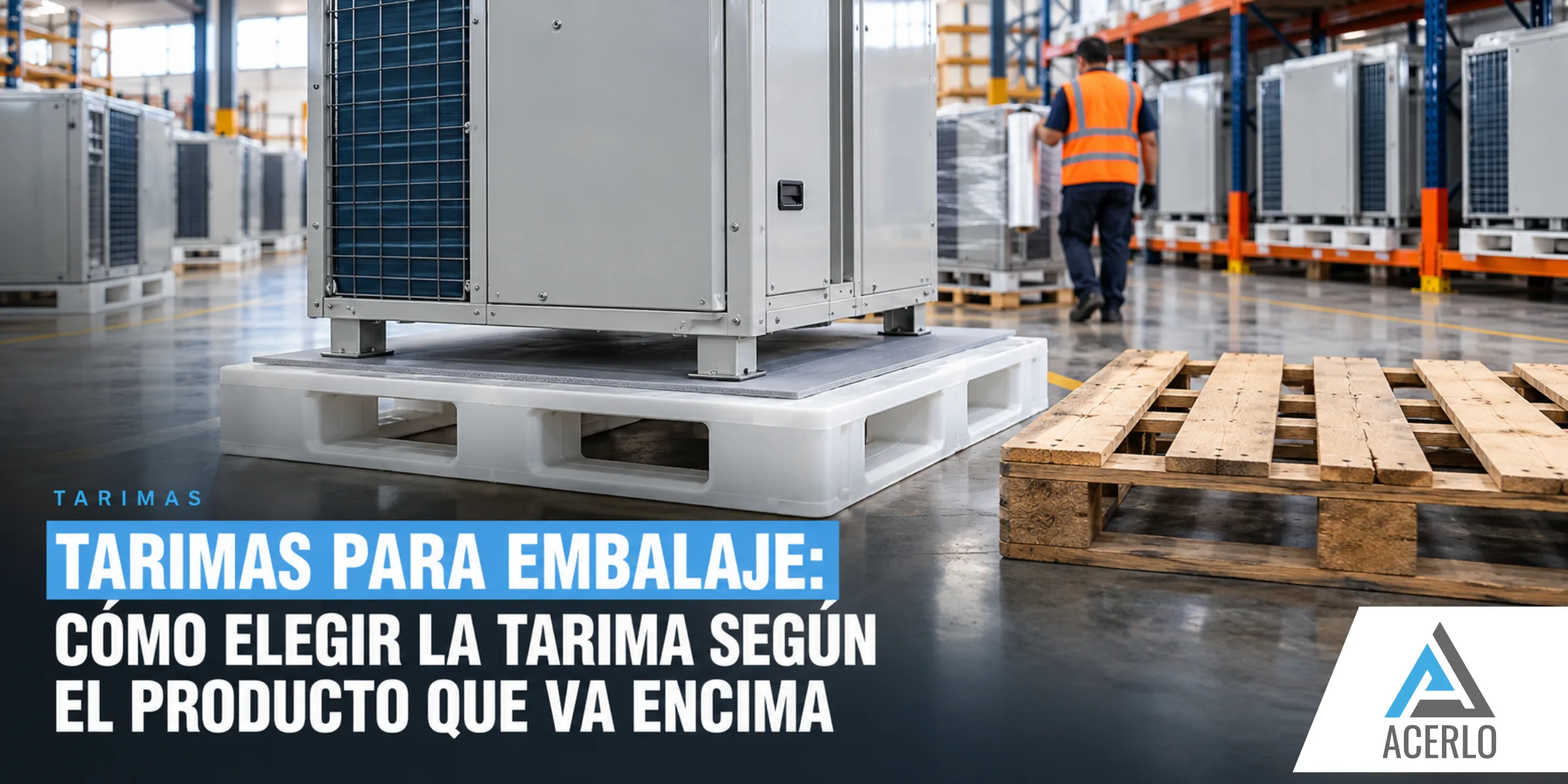
A plant in Apodaca, near Monterrey, makes sheet metal cabinets for air conditioning units and ships them on the same 39.4 × 47.2 in (100 × 120 cm) wood pallets it has used for years. Early in the month the model changes: the new cabinet is heavier, comes painted in a light color and rests on four narrow legs. The pallet goes unchecked, because the size is the same and the cabinet fits on the deck.
On the first shipment, two of the legs land over the gap between two deck boards. When the forklift lifts the pallet, a board gives way, the cabinet tilts and its painted side scrapes against the nail sticking out of the broken board. At the customer's dock more cabinets show up scratched from rubbing against the wood during the trip, and receiving rejects the lot. The plant repacks, repaints parts and pays for a second freight run on a product that left the line in perfect shape.
The types of pallets are classified by material, entries, use and size. Here we start with what goes on top, because at many plants the pallet is bought once, for everything, and stays in use when the product, the customer or the destination changes.
A packaging pallet is the base of the unit load: the pallet, the product, the dunnage and the stretch film travel together. If one piece does not match the product, the failure shows up at the weakest point, and it is discovered at the customer's dock, when there is no longer any way to fix it.
We think of the unit load as a design that gets approved before the first shipment: the pallet carries the weight, the pattern spreads it, the dunnage keeps parts from touching and the stretch wrap holds everything in place. When the product changes, even in one leg or one finish, the whole design gets reviewed. In Apodaca, the pallet worked for the old cabinet and nobody evaluated it again with the new one.
A pallet can arrive sound from the supplier and still fail with your product. We see four traits that explain most of those failures.
Static load is what the pallet holds resting on the floor. Dynamic load is what it holds while the forklift or the pallet jack moves it, through every start and every stop. The second is always lower, and it is the one to compare with the weight of your loaded pallet. The Stiropallet plastic pallet, in its standard 39.4 × 47.2 in (100 × 120 cm) size, holds up to 4,400 lb (2,000 kg) of static load and 1,760 lb (800 kg) of dynamic load. If your product with its packaging weighs more than 1,760 lb (800 kg), that is where the conversation starts.
Two products of the same weight can ask very different things of a pallet. A pallet of boxes spreads the weight over the whole deck. A cabinet on legs, a motor on its base or a casting puts that same weight on a few square inches. On a wood pallet, that point can land on a thin board or over the gap between two boards, as it did in Apodaca.
For these products, a continuous deck with no gaps between boards works better, or a sheet that spreads the support. A corrugated plastic sheet between the part and the pallet helps distribute the load and protects the base of the product. The sheet gauge is chosen by the weight of the part, and we recommend it from your product data.
The product's base has to match the pallet deck. If the product overhangs, the edges take the hits from the forklift, the neighboring pallet and the trailer walls, and the bottom boxes lose support at their corners, right where they are strongest. If it falls short, the pallet takes up space that carries no product and the boxes shift inside the stretch wrap at every stop.
That is why the pallet size is chosen from the base of the product or of the box pattern, and from the size your customer accepts. In Mexico the most common is 39.4 × 47.2 in (100 × 120 cm), the standard size of our Stiropallet plastic pallet; the other pallet sizes used in Mexico serve different destinations and loads.
The deck touches the base of the product for the whole trip. A splintered board, a protruding nail or a damp stain marks a painted part, tears a sack and soils the cardboard. The Stiropallet plastic pallet has a smooth, hygienic, non-porous surface, with no splinters, nails or pests. For parts with a painted or finished surface, we add class A corrugated plastic dunnage, which resists abrasion without marking the material.
With those four traits you can read which pallet your product calls for. These are the cases we see most when quoting.
Corrugated cardboard is strongest at its corners and vertical walls, and it loses strength when it absorbs moisture. On a wet wood pallet, the bottom of the stack takes on water during the trip and the lower boxes give way under the weight of the ones above. Cardboard calls for a dry pallet that matches the box pattern exactly. The Stiropallet plastic pallet does not absorb moisture and keeps its weight in the rainy season.
A full sack settles to the shape of the pallet and puts all its weight on the deck. A nail or a splinter punctures it, and the bulk product leaks through the hole during transit. Woven polypropylene sacks call for a smooth surface with no joints that pinch the weave. At ACERLO we make custom woven polypropylene sacks up to 72 in (1.83 m) wide and in whatever length you need.
An auto part, a cabinet or a marble slab can be rejected for a scratch even though it works perfectly. With these products, the pallet handles support and the dunnage handles protection: it keeps parts from touching each other or the deck. At our plant in Santa Catarina we cut, die-cut and assemble corrugated plastic dunnage in the exact shape of your part. We also offer industrial crates with dividers on a 47.2 × 39.4 in (1200 × 1000 mm) base, the same footprint as the 39.4 × 47.2 in (100 × 120 cm) pallet.
In a food or beverage plant, the pallet enters areas where cleaning and pest control are managed. Wood is porous, holds moisture and can bring splinters or insects in from the yard. The Stiropallet plastic pallet is used in food and beverages because it is hygienic, non-porous, water resistant and easy to clean.
Pharmaceuticals and electronics add another requirement: the pallet must keep splinters and wood dust away from a sensitive product. If the shipment also goes by air, every pound counts, because air freight is charged by weight: the Stiropallet plastic pallet weighs 9.9 lb (4.5 kg), and a wood pallet of the same size, 33 to 55 lb (15 to 25 kg). Our site has a freight savings calculator to compare the two.
When the product crosses into the United States, the destination joins the list. Every wood pallet must comply with ISPM 15, with heat treatment or fumigation and the IPPC stamp visible. The Stiropallet plastic pallet complies with ISPM 15 with no treatment, no fumigation and no stamp, because those requirements apply only to wood, and it crosses the border with no phytosanitary paperwork.
In 25 years of experience in the industry, we have seen that this review takes an afternoon and prevents a rejected lot. Do it with quality, warehouse and shipping, with the product in front of you:
At ACERLO we quote from the dimensions of your product or part, your monthly quantity and the destination. We manufacture the Stiropallet plastic pallet at our plant in Santa Catarina and deliver it to your plant in 3 to 5 days near Monterrey and in 5 to 10 days in the rest of Mexico and in the United States. If your product also needs corrugated plastic dunnage or woven polypropylene sacks, all your packaging is quoted together and arrives together.
A packaging pallet is chosen by reading the product on top: its weight, its support, its base, its surface and its destination. If you want to review the pallet for your next shipment, send us your dimensions, your monthly volume and your destination through the quote form at https://acerlo.com.mx/en/, and at ACERLO we will reply with the proposal for your packaging.
Frequently Asked Questions
You can, as long as they all weigh, rest and travel in a similar way. As soon as a product concentrates its weight on a few points, has a painted finish, enters a clean area or crosses the border, it pays to review the pallet for that specific product.
One with a smooth, non-porous, washable surface, with no splinters or nails. The Stiropallet plastic pallet is used in food, beverages, pharmaceuticals and electronics, and it suits plants that reject wood pallets.
The dimensions of your product or part, your monthly quantity and the destination. If you send us a drawing or a photo of the load, the quote comes back faster, and the formal proposal with price and lead time reaches you by email.
Keep Reading
39.4 × 47.2 in for Mexico, 48 × 40 in for the U.S., the euro pallet for Europe and the square pallet for drums. How to pick yours.
Read ArticleHeat and EPS versus boards and nails. How the manufacturing process decides your pallet's weight, moisture, surface and paperwork at the border.
Read ArticleAn industrial pallet is bought with a spec sheet. The data it carries and when you need it: racking, export, clean areas, returnable packaging and audits.
Read Article24 to 28 pallets of 39.4 × 47.2 in per level, depending on the pattern, and up to twice that double stacked. The math with width, height and weight.
Read ArticleTarima in Mexico, pallet in English, palet in Spain. The sizes and units each name carries and how to write the pallet on a purchase order.
Read ArticleWood or Stiropallet, two or four-way entry, one-way or returnable, 100 × 120 cm or 40 × 48 in. How to choose a pallet by the load.
Read ArticleA pallet turns loose boxes into one unit load a forklift moves at once. Its parts, its capacity and how to choose one.
Read ArticleRequest a Quote
Send us your dimensions, monthly volume, and destination, and we will reply with pricing.