Packaging
Types of Industrial Packaging With Examples by Industry
Packaging is classified by function, material and number of trips. The mix each industry uses, from painted auto parts to steel coils.
Read Article
BlogPallets
In Mexico the standard pallet measures 39.4 × 47.2 in (100 × 120 cm). The U.S. standard is 48 × 40 in, about 122 × 102 cm. Height is a separate figure, and it goes on the order too.
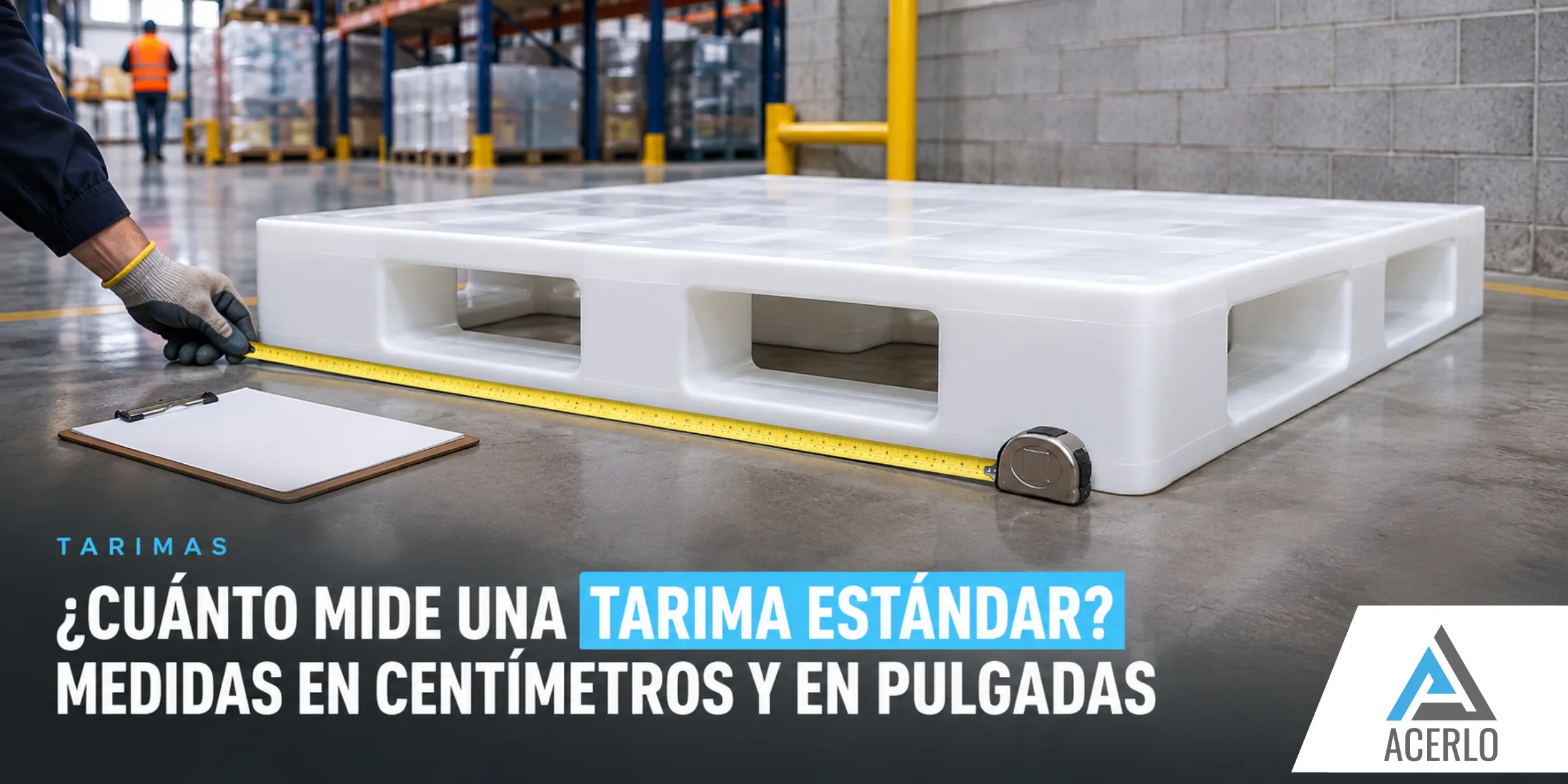
A tempered glass plant in García, near Monterrey, lands a large order from a customer in Texas, and purchasing orders two hundred “standard” pallets from a new supplier without writing down the height or the unit of measure. The pallets arrive in wood, with the 39.4 × 47.2 in (100 × 120 cm) deck everyone expected and a height of almost 6.3 in (16 cm), about an inch more than the ones the plant used to run. Seen from the front in the yard, they look identical, and nobody notices the difference.
The load plan for the 53-foot trailer was built on three tiers per position. With the new height, the third tier no longer fits under the trailer roof, and the shipment leaves with a third less product. The plant books a second truck, arrives late to the Texas customer and then finds out that the customer's spec called for 48 × 40 in, a size purchasing had converted from memory. Two numbers written wrong on a purchase order end up costing a full truckload.
When a purchase order says “standard pallet” and nothing else, the supplier delivers whatever size it considers standard. In northern Mexico, that is almost always the 39.4 × 47.2 in (100 × 120 cm) pallet. A supplier that serves border maquiladoras may send the 48 × 40 in pallet. Both exist, both are called standard, and they differ by fractions of an inch that a rack, an automated line or a load plan will notice.
Then there is height, the figure that almost never gets written down. Two pallets with the same deck and a different height change how many tiers fit in a truck and how many empty pallets stack in the warehouse. In García, the deck was right, and the height sent a third of the product to a second truck.
A complete pallet size has a length, a width, a height and the unit they are expressed in. Our Stiropallet plastic pallet, for example, measures 39.4 × 47.2 × 5.3 in (100 × 120 × 13.5 cm): the first number is the width where the forklift forks enter, the second is the length and the third is the overall height. Writing all three and adding “in” or “cm” leaves no doubt for the supplier, for the warehouse that receives the pallets and for shipping, which builds the load plan around that height.
One inch equals 2.54 centimeters, so every pallet size has an exact equivalent in the other unit. Trouble starts when that conversion gets rounded and one size ends up mistaken for another. These are the equivalents worth keeping at hand.
The most common pallet in Mexico measures 100 cm wide by 120 cm long, written as 1.00 × 1.20 m or 1,000 × 1,200 mm depending on the document. Converted to inches, it measures 39.37 × 47.24 in. That is the deck of our Stiropallet plastic pallet, which is also 5.3 in (13.5 cm) tall and weighs 9.9 lb (4.5 kg); a wood pallet of the same size weighs 33 to 55 lb (15 to 25 kg).
This size matches the 47.2 × 39.4 in (1200 × 1000 mm) base of our industrial crates with dividers, and it is the size used by the selective racks, production lines and domestic distribution centers we see most often when we quote.
In the United States the reference size is 48 × 40 in, which converts to 121.9 × 101.6 cm. In Mexico many plants write it as 1.22 × 1.02 m. A U.S. customer orders it in inches, its rack is set to it and its automated line recognizes it through its sensors. If your plant supplies Texas or the border region, this is the size that shows up in the packaging spec.
Watch the order of the numbers. In the United States the length comes first, 48, followed by the width, 40, which is the side where the forklift forks enter. In Mexico the custom is the reverse: width first, then length. When purchasing converts “48 × 40” into “120 × 100” without stating the order, the warehouse can receive the pallet turned from what the rack expects.
The euro pallet measures 1,200 × 800 mm, or 47.24 × 31.5 in. In Mexico it shows up at plants that supply European groups or that receive machinery and spare parts from that continent. It shares the 47.2 in (120 cm) length of the Mexican pallet, but its 31.5 in (80 cm) width completely changes how it fits in a trailer and in a rack.
The difference between the 39.4 × 47.2 in (100 × 120 cm) pallet and the 48 × 40 in pallet is 0.75 in (1.9 cm) in length and 0.63 in (1.6 cm) in width. To the eye they are the same pallet. On a line with tight guides, in a rack built to an exact size or in a trailer loaded to the doors, those fractions of an inch decide whether the pallet fits or stays out. That is why the unit and the exact size are written in full, and the conversion is done with 2.54, never from memory.
Pallet height almost never appears on a purchase order and almost always appears in the load plan. Each tier adds the height of the load plus the height of the pallet. If the pallet is 6.3 in (16 cm) tall instead of 5.3 in (13.5 cm), each tier grows by about 1 in (2.5 cm); with three tiers, the stack grows by about 3 in (7.5 cm), enough to keep the top tier from fitting under the trailer roof, as happened in García.
The rack works the same way as the truck. The beam spacing was set for one pallet height; if a taller pallet arrives, the loaded pallet rubs the beam above it or no longer fits at all. Before you change suppliers or models, measure the overall height of the new pallet and subtract it from the clearance of your rack and your trailer. Stiropallet plastic pallets keep their 5.3 in (13.5 cm) on every piece, because we thermoform them to the same size at our plant in Santa Catarina.
Height also decides how many empty pallets fit in a stack and how much floor they take up. At plants where pallets come back, the space to store them empty is part of the cost. A lower, lighter pallet, like the 9.9 lb (4.5 kg) plastic one, stacks and moves with less effort than a 33 to 55 lb (15 to 25 kg) wood pallet.
Beyond length and width, it matters where the equipment goes in. A two-way pallet can only be lifted from two of its sides; a four-way pallet can be lifted from all four. On a two-way pallet, 39.4 × 47.2 and 47.2 × 39.4 behave differently at the dock, because the forklift picks the pallet up from one side or the other and the load ends up facing the opposite direction inside the trailer.
That is why we recommend writing the size in the same order on every plant document: packaging spec, purchase order, load plan and shipping label. An agreement as simple as “width × length × height, in inches” keeps every department from reading the same pallet a different way.
In 25 years of experience in the industry, we have seen that returns over pallet size get solved with a well-written purchase order. This is the review we recommend before ordering pallets for a new product or customer:
With that order, the supplier delivers what you expected, the warehouse receives it with no surprises and shipping keeps the load plan it used to quote the freight.
At ACERLO we manufacture Stiropallet plastic pallets in Santa Catarina in a standard size of 39.4 × 47.2 × 5.3 in (100 × 120 × 13.5 cm), rated for up to 4,400 lb (2,000 kg) of static load and 1,760 lb (800 kg) of dynamic load. They comply with ISPM 15 with no heat treatment, no fumigation and no stamp, because those requirements apply only to wood, and they cross into the United States with no phytosanitary paperwork. To get a quote, send us your product dimensions, your monthly quantity and the destination; we deliver to your plant in 3 to 5 days near Monterrey and in 5 to 10 days in the rest of Mexico and in the United States. If you also need corrugated plastic dividers or woven polypropylene bags, all your packaging is quoted together and arrives together.
A standard pallet size has three numbers and a unit: 39.4 × 47.2 × 5.3 in (100 × 120 × 13.5 cm) in Mexico, 48 × 40 in for the United States and 47.2 × 31.5 in (120 × 80 cm) for Europe. If you want to confirm the size for your next pallet order, request your quote with your product dimensions, your monthly volume and your destination, and at ACERLO we will reply with the proposal for your packaging.
More on plastic pallets: plastic pallet manufacturer.
Frequently Asked Questions
39.37 × 47.24 in, which is 100 × 120 cm or 1.00 × 1.20 m. Our Stiropallet plastic pallet measures 39.4 × 47.2 × 5.3 in (100 × 120 × 13.5 cm) and weighs 9.9 lb (4.5 kg).
It depends on the market. The U.S. pallet measures 48 × 40 in, about 122 × 102 cm. The Mexican standard, 100 × 120 cm, equals 39.4 × 47.2 in. It pays to write both units on the purchase order.
Because every stacking tier adds the height of the pallet. An inch or so more per pallet can push the top tier out of the trailer or make the load rub the rack beam.
Keep Reading
Packaging is classified by function, material and number of trips. The mix each industry uses, from painted auto parts to steel coils.
Read ArticleTertiary packaging protects the entire load in transit. How to tell it apart from primary and secondary packaging so no layer goes without an owner.
Read Article10 boxes per layer instead of 9 and 5 layers under a 55.1 in rack. The full math with an example, from the deck to the pallets per month.
Read ArticleThe 39.4 × 47.2 in wood pallet has a direct equivalent that keeps your pattern and load plan. Five figures change, from height to the border.
Read Article39.4 × 47.2 in for Mexico, 48 × 40 in for the U.S. and 47.2 × 31.5 in for Europe. How they differ and which one your customer's rack expects.
Read Article39.4 × 47.2 in for Mexico, 48 × 40 in for the U.S., the euro pallet for Europe and the square pallet for drums. How to pick yours.
Read ArticleWeight, support, base, surface and destination. The five product facts that decide the size, load rating and material of your packaging pallet.
Read ArticleHeat and EPS versus boards and nails. How the manufacturing process decides your pallet's weight, moisture, surface and paperwork at the border.
Read ArticleAn industrial pallet is bought with a spec sheet. The data it carries and when you need it: racking, export, clean areas, returnable packaging and audits.
Read Article24 to 28 pallets of 39.4 × 47.2 in per level, depending on the pattern, and up to twice that double stacked. The math with width, height and weight.
Read ArticleTarima in Mexico, pallet in English, palet in Spain. The sizes and units each name carries and how to write the pallet on a purchase order.
Read ArticleWood or Stiropallet, two or four-way entry, one-way or returnable, 100 × 120 cm or 40 × 48 in. How to choose a pallet by the load.
Read ArticleA pallet turns loose boxes into one unit load a forklift moves at once. Its parts, its capacity and how to choose one.
Read ArticleRequest a Quote
Send us your dimensions, monthly volume, and destination, and we will reply with pricing.