Packaging
Types of Industrial Packaging With Examples by Industry
Packaging is classified by function, material and number of trips. The mix each industry uses, from painted auto parts to steel coils.
Read Article
BlogPackaging
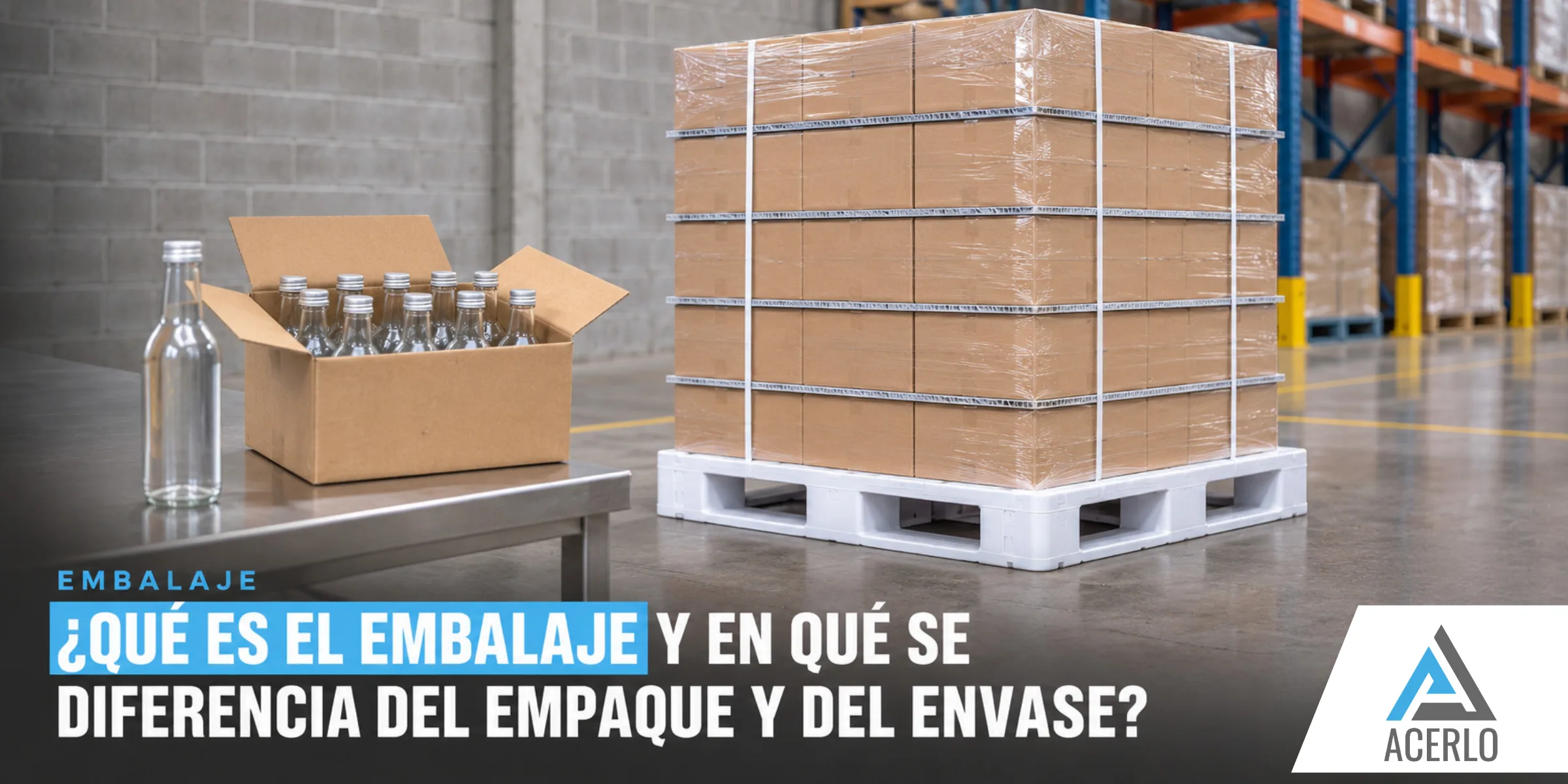
Tertiary packaging, also called transport packaging, is the outer protection that groups a load so it can be stored and shipped. Primary packaging holds the product and touches it; secondary packaging groups several primary units to sell or handle them together; tertiary packaging, built on a pallet, protects the whole set in transit.
An auto parts plant wins a new customer and receives its supplier manual. In the packaging section, the customer asks the plant to approve the primary, secondary and tertiary packaging for each part number before the first shipment. Purchasing reads the three terms as one and the same and quotes corrugated boxes printed with the plant logo. Nobody quotes dividers, pallets or covers, because nobody at the plant understood that tertiary packaging was a separate requirement.
The first shipment leaves with the painted parts inside the new boxes, stacked on wood pallets from the yard and with no dividers. At the customer's receiving dock, quality opens the boxes and finds scratches on the parts along the edges and splinters at the base of the stack. The entire lot comes back, and the customer issues a nonconformance because the tertiary packaging was never submitted for approval. The plant loses the round-trip freight, a shift of rework and the trust of a customer that was just getting started.
On the plant floor, people use the word packaging for everything. In a packaging spec, a purchase order or the supplier manual of a large plant, primary, secondary and tertiary packaging each point to a different level of protection, with its own material, owner and requirement. If your team mixes them up, one of the three layers ends up with no owner, and that layer is the one that fails in transit.
The clearest way to tell them apart is by what each one touches. Primary packaging touches the product, secondary packaging touches the primary units and tertiary packaging touches the entire load.
Primary packaging is the first level of protection. It holds the product, touches it directly and preserves its condition: the bottle of a beverage, the vial of a medicine, the bag that holds an electronic board or the can of a lubricant. NOM-051-SCFI/SSA1-2010, the Mexican labeling standard for prepackaged food and nonalcoholic beverages, defines the container (envase) as any receptacle or wrapping that holds the prepackaged product for sale to the consumer.
Primary packaging carries the commercial information the end user reads: contents, lot and instructions for use. That is why its design goes through marketing, quality and the product's regulatory team. A change to the primary packaging means reviewing the label, and a change to the label means reviewing the primary packaging.
Secondary packaging is the second level. It groups several primary units into one unit that is sold, counted or handled together: the case of twelve bottles, the six-pack of cans or the corrugated box with twenty vials. The same NOM-051 calls a multiple or collective container one that holds two or more units of prepackaged product meant to be sold in that presentation.
Secondary packaging is moved by hand. An operator carries it, a warehouse worker stacks it and it reaches the shelf or your customer's line. In everyday use, the word packaging also covers everything that protects a product, and we ourselves talk about industrial packaging. In a technical document, it pays to reserve secondary packaging for this second level and name tertiary packaging separately.
Tertiary packaging is the third level. It groups cases, parts or bundles into a single load and protects it in the warehouse, during handling and on the road. NOM-051 defines it (embalaje) as the material that wraps, holds and protects prepackaged products for storage and transport. At a plant, that material is the pallet, the dividers, the stretch film, the corner boards, the crate or the cover that wraps a coil.
Tertiary packaging is moved with a forklift or pallet jack, and it takes up a position in the rack and another on the truck floor. Its design belongs to logistics, shipping and supplier quality. At the end of the trip, your customer removes it at receiving or sends it back to your plant if it is returnable.
The line between secondary and tertiary packaging is where teams get confused most, because both can be a corrugated box. To place each piece, we use a practical question: how does it move? If it moves by hand and reaches the shelf or the line, it belongs to secondary packaging. If it moves by forklift, stacks in a rack or rides strapped down in the truck, it belongs to tertiary packaging.
A beverage shows it clearly. The bottle is the primary packaging. The case of twelve bottles is the secondary packaging. The pallet with several layers of cases, stretch-wrapped and with corner boards, is the tertiary packaging that goes onto the truck. Each level has its own failure: the bottle that breaks, the case that gets crushed and the stack that leans in a curve.
In heavy industry, many products travel with no primary or secondary packaging. A steel coil, a cable reel or a marble slab goes straight to tertiary packaging: the base that supports it, the cover that wraps it and the dunnage that holds it still. In those cases, tertiary packaging is the only protection the product has, and any failure in it reaches your customer as a scratch, a dent or a broken edge.
Mixing up the terms causes concrete problems in purchasing, quality and compliance. These are the three we see most when we review specs with our customers.
When the purchase order just says packaging, each supplier quotes what it understands by that word. One quotes boxes, another quotes bags and nobody quotes the pallet or the dividers. The load ships with the missing layer solved at the last minute, with whatever pallet is in the yard and no dunnage between parts, as happened at the auto parts plant at the start.
Each level has its own requirement. The commercial information required by NOM-051 goes on the primary packaging. Wood packaging that crosses borders answers to a different standard, International Standard for Phytosanitary Measures No. 15 (ISPM 15), from the International Plant Protection Convention (IPPC). That standard regulates wood packaging material used in international trade, including pallets and wood dunnage. If your spec calls the pallet secondary packaging, the treatment and stamp requirement can slip out of the review, and a wood pallet with no stamp stops the shipment at the border.
A customer with a supplier manual approves the three levels separately. If your plant submits only the primary and secondary packaging, the approval stays incomplete even when the product complies. The nonconformance comes from a missing document, and the lot waits at your customer's receiving dock while quality sorts it out.
Within tertiary packaging, the pallet is the piece that holds up the rest. The function of a pallet is to turn many loose pieces into a single load that is lifted by forklift, stacked in a rack and takes up one position in the truck. The dividers, the stretch wrap and the corner boards are built on top of it, and together they form the unit load that travels whole to your customer's receiving dock.
At our plant in Santa Catarina we manufacture the Stiropallet plastic pallet, thermoformed from expanded polystyrene (EPS), in a standard size of 39.4 × 47.2 × 5.3 in (100 × 120 × 13.5 cm). It weighs 9.9 lb (4.5 kg), against 33 to 55 lb (15 to 25 kg) for a wood pallet of the same size, and holds up to 4,400 lb (2,000 kg) of static load and 1,760 lb (800 kg) of dynamic load. Its surface is smooth and nonporous, with no splinters or nails to mark the boxes on the bottom layer. It also complies with ISPM 15 with no treatment, no fumigation and no stamp, because those requirements apply only to wood.
That is why we recommend designing tertiary packaging as a set. At ACERLO we supply pallets, corrugated plastic, dividers and woven polypropylene bags, and all your packaging is quoted together and arrives together. That way the pallet, the dividers and the cover are specified with the same dimensions and reach your plant in the same shipment.
Before you quote or submit your packaging to a customer, review your spec with quality, purchasing and shipping at the same table. These five steps put the three levels in order:
With the three levels in writing, each supplier quotes its part, each department knows what it approves and the load leaves your plant with all its layers.
To quote your tertiary packaging with us, send us the dimensions of your product or part, your monthly quantity and the destination; a drawing or a photo speeds up the quote. We deliver to your plant in 3 to 5 days near Monterrey and in 5 to 10 days in the rest of Mexico and in the United States.
Primary, secondary and tertiary packaging are three layers with three owners, and the third one takes the hits of the trip. If you want to review the tertiary packaging of your load, request your quote with the dimensions of your product, your monthly volume and your destination, and at ACERLO we will reply with the proposal for your packaging.
More on corrugated plastic: class A protection dunnage, reusable packaging containers, plastic sheet distribution, and plastic cardboard.
Frequently Asked Questions
A pallet belongs to tertiary packaging. It supports the entire load, moves by forklift or pallet jack and rides in the truck, which are the traits of the third level. That is why it goes in the tertiary packaging section of your spec, along with the dividers, the stretch wrap and the corner boards.
If the dividers travel inside the crate or the shipping box so parts do not touch in the truck, they are part of tertiary packaging. We design them in corrugated plastic in the exact shape of each part, and returnable dividers go back to your production line after each trip.
Plants in Mexico use envase for primary packaging, empaque for secondary packaging and embalaje for tertiary or transport packaging. If your supplier in Mexico sends you its spec in Spanish, place each term at its level before you approve it, so both documents describe the same three layers.
Keep Reading
Packaging is classified by function, material and number of trips. The mix each industry uses, from painted auto parts to steel coils.
Read Article10 boxes per layer instead of 9 and 5 layers under a 55.1 in rack. The full math with an example, from the deck to the pallets per month.
Read ArticleThe 39.4 × 47.2 in wood pallet has a direct equivalent that keeps your pattern and load plan. Five figures change, from height to the border.
Read Article39.4 × 47.2 in for Mexico, 48 × 40 in for the U.S. and 47.2 × 31.5 in for Europe. How they differ and which one your customer's rack expects.
Read Article39.4 × 47.2 in for Mexico, 48 × 40 in for the U.S. and 47.2 × 31.5 in for Europe. The exact conversions and why height counts too.
Read Article39.4 × 47.2 in for Mexico, 48 × 40 in for the U.S., the euro pallet for Europe and the square pallet for drums. How to pick yours.
Read ArticleWeight, support, base, surface and destination. The five product facts that decide the size, load rating and material of your packaging pallet.
Read ArticleHeat and EPS versus boards and nails. How the manufacturing process decides your pallet's weight, moisture, surface and paperwork at the border.
Read ArticleAn industrial pallet is bought with a spec sheet. The data it carries and when you need it: racking, export, clean areas, returnable packaging and audits.
Read Article24 to 28 pallets of 39.4 × 47.2 in per level, depending on the pattern, and up to twice that double stacked. The math with width, height and weight.
Read ArticleTarima in Mexico, pallet in English, palet in Spain. The sizes and units each name carries and how to write the pallet on a purchase order.
Read ArticleWood or Stiropallet, two or four-way entry, one-way or returnable, 100 × 120 cm or 40 × 48 in. How to choose a pallet by the load.
Read ArticleA pallet turns loose boxes into one unit load a forklift moves at once. Its parts, its capacity and how to choose one.
Read ArticleRequest a Quote
Send us your dimensions, monthly volume, and destination, and we will reply with pricing.