An air conditioning equipment plant has shipped everything the same way for years: corrugated boxes on one-way wood pallets, stretch-wrapped at the dock. A new customer asks for returnable packaging for the painted cabinets and dividers between parts. The plant answers that its usual packaging has always worked and keeps it for the new customer.
The first month falls in the rainy season. The boxes on the bottom layer soak up moisture from the pallet and collapse under the weight of the layers above. The cabinets arrive with dented corners and scratched paint. The customer rejects the lot, charges for the return handling and gives the plant one month to present different packaging. The plant finds that it does not know which type of packaging to ask for, because it never had to choose one.
One Packaging Setup for Everything, the Habit You Pay For at Your Customer's Dock
Many plants use the same packaging for all their products because that is what they inherited. It works as long as the product, the customer and the route stay the same. When one of the three changes, the usual packaging stops protecting, and the failure shows up at the customer's receiving dock, far from your plant.
Choosing well starts with knowing the types of packaging that exist. We classify them three ways: by the function each piece serves in the load, by the material it is made of and by the number of trips it makes. Complete packaging combines several types at once.
Types of Packaging by the Function They Serve in the Load
Each piece of packaging solves a different problem: supporting, containing, separating, wrapping or holding bulk product. A well-designed load covers every function its product needs.
Support packaging, the pallet that carries the load
The pallet is the base everything else is built on. It takes the weight of the load, lets a forklift or pallet jack lift it and places it in the rack and in the truck. The types of pallets vary by material, entries and size. Within the packaging, they all do the same job: carry the weight while the load sits still and while it moves.
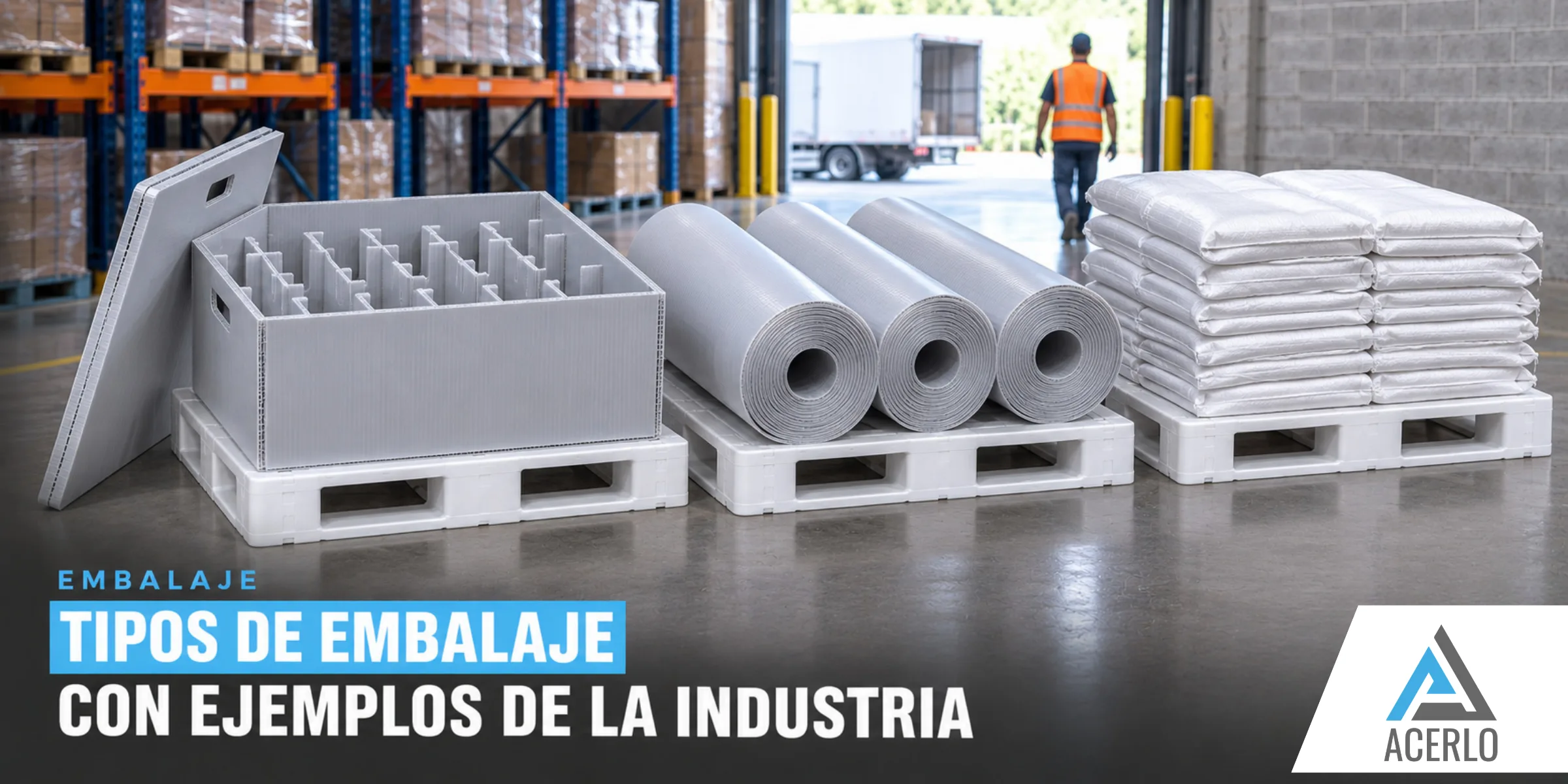
Industry example: in food, pharmaceuticals and electronics, many plants do not accept wood pallets in their areas. For them we manufacture the Stiropallet plastic pallet, thermoformed from expanded polystyrene (EPS), at 39.4 × 47.2 × 5.3 in (100 × 120 × 13.5 cm) and 9.9 lb (4.5 kg), rated for 4,400 lb (2,000 kg) of static load and 1,760 lb (800 kg) of dynamic load. Its smooth, nonporous surface does not absorb moisture and cleans with water.
Containment packaging, boxes and crates that keep the load together
Containment packaging surrounds the product so it does not shift or fall out of the load. This group includes shipping boxes and crates, which gather loose parts into a fixed volume that stacks and moves as a single unit.
Industry example: in automotive, auto parts travel in industrial crates with dividers. The crates we offer have a 47.2 × 39.4 in (1200 × 1000 mm) base, the same footprint as a 39.4 × 47.2 in (100 × 120 cm) pallet. They come in the low models H15, H25 and H40 and in the high model H100, at 39.4 in (1,000 mm), with load ratings from 551 to 1,543 lb (250 to 700 kg). For custom orders, we adjust dimensions, internal dividers, plastic color and markings with your plant logo.
Separation packaging, dividers and dunnage
Inside the box or crate, parts hit and scratch each other every time the truck brakes. Separation packaging keeps them apart. Dunnage fills the gaps so nothing moves.
Industry example: in heating, ventilation and air conditioning (HVAC), dividers isolate each component; in automotive, they prevent scratches and dents on auto parts. For painted or finished surfaces there is class A dunnage, which protects the finish. At our plant in Santa Catarina we cut, die-cut and assemble corrugated plastic dividers in the exact shape of each part, and we make them returnable so they go back to the production line.
Wrapping packaging, rolls, covers and film
Some products do not fit in a box. For them, the packaging wraps: it covers the surface, protects it from impact, dust and moisture, and holds the load together. Stretch film does this job over the boxes on a pallet. Corrugated plastic rolls and sheets do it over heavy or finished products.
Industry example: in steel and aluminum, corrugated plastic rolls wrap coils of 3 to 20 metric tons in transit. In the cable industry, they cover the reels. In marble and construction, the sheet protects finished surfaces without marking them, because corrugated polypropylene resists abrasion.
Flexible packaging for bulk, woven polypropylene sacks and bags
Bulk product needs packaging that takes its shape and keeps it closed. Woven polypropylene sacks and bags serve that function. They protect against dust, moisture, dirt and splashes during storage and transport, and they stack in layers on the pallet.
Industry example: we make custom woven polypropylene bags and sacks up to 72 in (1.83 m) wide and in whatever length your product requires. If your bulk product is stored outdoors, specify ultraviolet (UV) resistance on your purchase request.
Types of Packaging by Material and What Each One Withstands
Function tells you what the piece does. Material tells you under what conditions it keeps doing it. These are the five materials we find most often in industrial packaging:
- Wood: strong and easy to repair; it absorbs moisture, gains weight in the rain and can bring splinters, nails or pests. A 39.4 × 47.2 in (100 × 120 cm) wood pallet weighs 33 to 55 lb (15 to 25 kg).
- Corrugated cardboard: light and easy to print; it loses strength when it absorbs moisture and works best for a single trip in a dry environment.
- Corrugated polypropylene plastic: it does not absorb water or warp with humidity, replaces cardboard in warehouses and cold rooms, and is reused trip after trip. We supply it in sheets and rolls, in thicknesses from 2 to 6 mm and basis weights from 350 to 1,300 g/m².
- Thermoformed expanded polystyrene: the material of the Stiropallet plastic pallet, light, with no splinters or nails and a smooth surface.
- Woven polypropylene: a light, durable fabric for bulk product that can be reused and is recyclable at the end of its life.
Material also decides the export paperwork. To enter the United States, all wood packaging, including pallets, crates and dunnage, needs an approved treatment and a visible, permanent stamp under International Standard for Phytosanitary Measures No. 15 (ISPM 15). The Stiropallet plastic pallet complies with ISPM 15 with no treatment, no fumigation and no stamp, because those requirements apply only to wood.
One-Way or Returnable Packaging, the Type That Sets Your Cost per Shipment
The third classification separates packaging that stays with the customer from packaging that comes back to your plant. One-way packaging is bought for each shipment and discarded or recycled at the destination. It makes sense for exports with no return route and for customers that do not send material back.
Returnable packaging is bought once and makes many trips between your plant and your customer's. It makes sense on fixed routes, with the same customer and the same product every week. Set up an agreement with your customer on who returns the material, how often and in what condition, because without that agreement returnable packaging stays on the customer's dock.
Industry example: in automotive, returnable corrugated plastic dividers go back to the production line on the return truck. The Stiropallet plastic pallet is reusable and suitable for racking, so it works in both schemes: it travels one way on an export and enters a closed loop when the route allows it.
Packaging Examples by Industry, the Combinations We Quote Most
In practice, each industry combines several types of packaging in the same load. These are the combinations we see most when quoting at ACERLO:
- Automotive: crate or box with corrugated plastic dividers and class A dunnage for painted parts, on a pallet.
- Steel and aluminum: corrugated plastic roll that wraps the coil in transit.
- Cable: corrugated plastic cover for the reel.
- Heating, ventilation and air conditioning: dividers between components and returnable packaging on fixed routes.
- Marble and construction: corrugated plastic sheet over the finished surface.
- Food, beverages and pharmaceuticals: Stiropallet plastic pallet, smooth and easy to clean, with stretch film.
- Electronics and air freight: the 9.9 lb (4.5 kg) Stiropallet plastic pallet, because air freight is charged by weight.
- Bulk product: woven polypropylene sacks stacked in layers on the pallet.
- Export to the United States: packaging with no wood, or wood with ISPM 15 treatment and stamp.
A single supplier simplifies this mix. At ACERLO we supply pallets, corrugated plastic, dividers and woven polypropylene bags, and all your packaging is quoted together and arrives together. We deliver to your plant in 3 to 5 days near Monterrey and in 5 to 10 days in the rest of Mexico and in the United States.
Types of packaging are chosen by function, by material and by number of trips, and the best-protected load combines all three criteria with your product and your route. If you want to review the packaging of your shipments, request your quote with the dimensions of your product, your monthly quantity and your destination, and at ACERLO we will propose the combination for your load.
More on corrugated plastic: plastic cardboard, corrugated polypropylene sheet, corrugated polypropylene panels, and coroplast corrugated plastic sheets.