Packaging
Types of Industrial Packaging With Examples by Industry
Packaging is classified by function, material and number of trips. The mix each industry uses, from painted auto parts to steel coils.
Read Article
BlogPallets
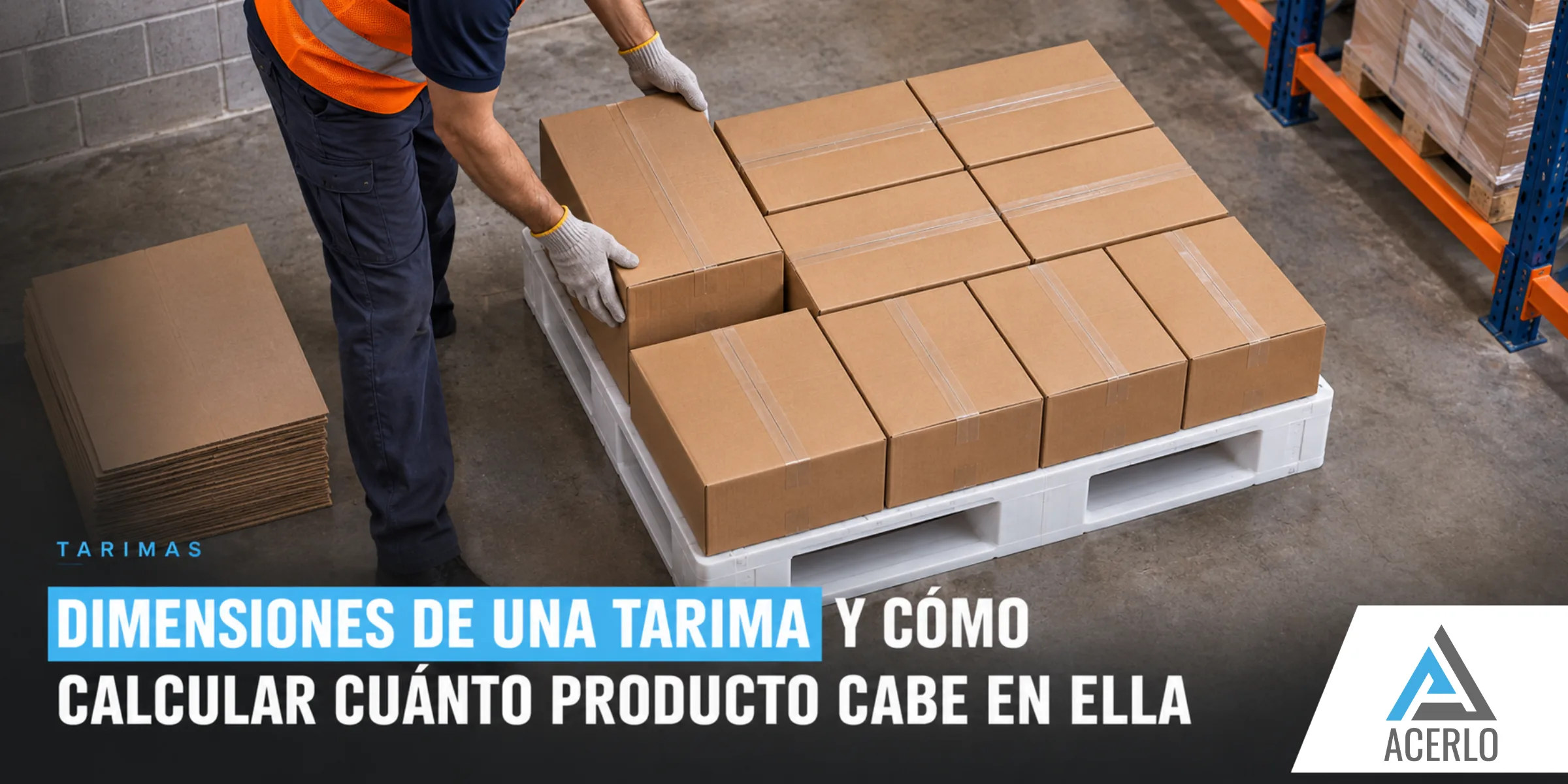
Boxes per layer times the number of layers gives the load on a pallet. The deck sets the boxes per layer, the clear height sets the layers and the dynamic load confirms whether the total can be moved.
An appliance replacement parts plant signs an annual contract with a national distributor and quotes freight per unit with quick math: sixty boxes per pallet, the number that worked with the previous product. From that figure it calculates how many pallets it will ship each month, how many trucks it needs and what it costs to move each box. The price is signed before the first pallet is built.
At the dock, the new box turns out to be taller than the old one. With the deck full and the height the distributor's rack accepts, fifty boxes fit per pallet. To ship the same volume, the plant needs a fifth more pallets, moves and trips, and every extra freight bill comes out of its margin for the full year of the contract. A three-minute calculation done from memory ended up signed into a price.
How many boxes fit on a pallet is the number that connects your product's dimensions with the cost of moving it. It sets the pallets you order each month, the trucks you hire and the per-unit freight you quote your customer. If that number is copied from a previous product, the error shows up on the first shipment and repeats on every one after it.
Here we work it out step by step, with a hypothetical example on a 39.4 × 47.2 in (100 × 120 cm) pallet, the standard size in Mexico. We do the division in centimeters, the unit the pallet is built in, and give inches next to each result.
A layer is one complete tier of boxes on the deck. The number of boxes per layer comes from dividing each side of the pallet by the side of the box that sits along it and keeping the whole number. For the example we use a hypothetical 15.7 × 11.8 × 9.8 in (40 × 30 × 25 cm) box that weighs 26.5 lb (12 kg) full.
If you place the 15.7 in (40 cm) side along the 47.2 in (120 cm) length, 3 boxes fit lengthwise (120 ÷ 40 = 3). The 11.8 in (30 cm) side runs along the 39.4 in (100 cm) width, and 3 boxes fit (100 ÷ 30 = 3.3, rounded down to 3). The layer holds 3 × 3 = 9 boxes and covers 47.2 × 35.4 in (120 × 90 cm) of the deck.
If you turn every box, the 11.8 in (30 cm) side runs along the length and 4 fit (120 ÷ 30 = 4). The 15.7 in (40 cm) side runs along the width and 2 fit (100 ÷ 40 = 2.5, rounded down to 2). The layer drops to 8 boxes. The same box on the same pallet gives 9 or 8 boxes depending on its orientation, and that difference multiplies across every layer and every pallet in the month.
The 9-box pattern leaves 3.9 in (10 cm) free across the width, a strip that travels empty on every layer. A combined pattern puts it to use. One row of 4 turned boxes, with the 11.8 in (30 cm) side along the length, takes up 47.2 × 15.7 in (120 × 40 cm). The rest of the deck, 47.2 × 23.6 in (120 × 60 cm), takes 2 rows of 3 boxes in the original orientation. The layer ends up with 4 + 6 = 10 boxes and covers the full 39.4 × 47.2 in (100 × 120 cm).
If you also reverse the pattern from one layer to the next, the seams do not line up between layers and the stack stays interlocked through the truck's braking.
The second number is how many layers you stack. It is set by the maximum height of the loaded pallet, and that height comes from the lowest point along the route, such as the beam spacing in the rack or the roof of the truck trailer. For the example we assume the customer's rack accepts loaded pallets up to 55.1 in (1.40 m).
From the 55.1 in (140 cm) you subtract the height of the empty pallet. With our 5.3 in (13.5 cm) Stiropallet plastic pallet, 49.8 in (126.5 cm) remain for product. Divide that height by the box height: 126.5 ÷ 25 = 5.06, so 5 layers fit. The loaded pallet stands 54.5 in (125 + 13.5 = 138.5 cm) and goes into the rack with 0.6 in (1.5 cm) to spare.
With 10 boxes per layer and 5 layers, the pallet carries 50 boxes. The block pattern would give 45, and the turned boxes, 40.
If the product needs a sheet between layers, its thickness adds to the height. A corrugated plastic sheet is 0.08 to 0.24 in (2 to 6 mm) thick, depending on the gauge, and the gauge is chosen by the weight of the product. In our example, a 0.2 in (5 mm) sheet under each of the 5 layers adds about 1 in (2.5 cm). The product reaches 50.2 in (127.5 cm), exceeds the 49.8 in (126.5 cm) of usable height, and the fifth layer no longer fits.
The fix is decided before the first shipment: a different gauge, sheets only on the layers that need them or a slightly shorter box.
The box on the first layer supports the weight of every box above it. In the example, each bottom box carries 4 boxes of 26.5 lb (12 kg), or 106 lb (48 kg). Compare that weight with the compression strength stated by the box manufacturer. If the box cannot take it, the packaging decides the number of layers, even if the height allows more.
The third number is the weight of the load. Multiply the number of boxes by the weight of each one and compare the result with the pallet's capacity. In the example, 50 boxes of 26.5 lb (12 kg) add up to about 1,320 lb (600 kg).
Our 39.4 × 47.2 in (100 × 120 cm) Stiropallet plastic pallet holds up to 4,400 lb (2,000 kg) of static load and 1,760 lb (800 kg) of dynamic load. Static load is what it holds resting on the floor. Dynamic load is what it holds while the forklift or the pallet jack moves it. Every loaded pallet gets moved at some point, so the number to compare is the dynamic load, and the 1,320 lb (600 kg) in the example stay within the 1,760 lb (800 kg).
If the same box weighs 39.7 lb (18 kg), the 50 boxes add up to about 1,985 lb (900 kg) and exceed the 1,760 lb (800 kg) dynamic load. In that case weight sets the limit: 800 kg ÷ 18 kg = 44.4, so 44 boxes fit. We recommend working with full layers, because a partial layer leaves boxes without side support. The result is 4 layers of 10 boxes, 40 boxes and about 1,590 lb (720 kg) per pallet, even though the height allows a fifth layer.
The practical rule is to calculate both limits, height and weight, and keep the lower one. Whichever arrives first decides how many boxes travel on each pallet.
With the boxes per pallet calculated, the rest is division. If your customer orders 2,000 boxes a month and each pallet carries 50, you need 40 pallets. With the 45-box block pattern, you would need 45 pallets (2,000 ÷ 45 = 44.4, rounded up), five more rack positions and five more moves every month.
That number of pallets is the input for the load plan. How many positions they take in a 48-foot trailer, and whether the truck maxes out on weight or on space, is calculated afterward, with the real size and weight of each loaded pallet.
In 25 years of experience in the industry, we have seen that this calculation fits on one sheet of paper. These are the seven steps we recommend, in this order:
With those seven steps, the per-unit price you quote your customer comes from math your team can check.
At ACERLO we manufacture the Stiropallet plastic pallet in Santa Catarina in a standard size of 39.4 × 47.2 × 5.3 in (100 × 120 × 13.5 cm), rated for up to 4,400 lb (2,000 kg) of static load and 1,760 lb (800 kg) of dynamic load, and suitable for racking. To get a quote, send us your box dimensions, your monthly quantity and the destination. We deliver to your plant in 3 to 5 days near Monterrey and in 5 to 10 days in the rest of Mexico and in the United States.
Pallet dimensions are the starting point of the calculation, and the pattern, the clear height and the weight decide how much product travels on top. If you want to review the load per pallet for your product, request your quote with your box dimensions, your monthly volume and your destination, and at ACERLO we will reply with the proposal for your packaging.
More on plastic pallets: plastic pallet manufacturer.
Frequently Asked Questions
Divide each side of the deck by the side of the box that sits along it and multiply the whole numbers, which gives the boxes per layer. Subtract the pallet height from the maximum allowed height and divide by the box height, which gives the layers. Multiply the two numbers and confirm that the weight stays within the dynamic load.
Try a combined pattern, with some of the boxes turned. In our example of a 15.7 × 11.8 in (40 × 30 cm) box on a 39.4 × 47.2 in (100 × 120 cm) pallet, the block pattern gives 9 boxes per layer and the combined pattern gives 10.
Whichever arrives first. Calculate the layers the height allows and the boxes the pallet's dynamic load allows, and keep the lower number. With light product, height sets the limit; with heavy product, weight does.
Keep Reading
Packaging is classified by function, material and number of trips. The mix each industry uses, from painted auto parts to steel coils.
Read ArticleTertiary packaging protects the entire load in transit. How to tell it apart from primary and secondary packaging so no layer goes without an owner.
Read ArticleThe 39.4 × 47.2 in wood pallet has a direct equivalent that keeps your pattern and load plan. Five figures change, from height to the border.
Read Article39.4 × 47.2 in for Mexico, 48 × 40 in for the U.S. and 47.2 × 31.5 in for Europe. How they differ and which one your customer's rack expects.
Read Article39.4 × 47.2 in for Mexico, 48 × 40 in for the U.S. and 47.2 × 31.5 in for Europe. The exact conversions and why height counts too.
Read Article39.4 × 47.2 in for Mexico, 48 × 40 in for the U.S., the euro pallet for Europe and the square pallet for drums. How to pick yours.
Read ArticleWeight, support, base, surface and destination. The five product facts that decide the size, load rating and material of your packaging pallet.
Read ArticleHeat and EPS versus boards and nails. How the manufacturing process decides your pallet's weight, moisture, surface and paperwork at the border.
Read ArticleAn industrial pallet is bought with a spec sheet. The data it carries and when you need it: racking, export, clean areas, returnable packaging and audits.
Read Article24 to 28 pallets of 39.4 × 47.2 in per level, depending on the pattern, and up to twice that double stacked. The math with width, height and weight.
Read ArticleTarima in Mexico, pallet in English, palet in Spain. The sizes and units each name carries and how to write the pallet on a purchase order.
Read ArticleWood or Stiropallet, two or four-way entry, one-way or returnable, 100 × 120 cm or 40 × 48 in. How to choose a pallet by the load.
Read ArticleA pallet turns loose boxes into one unit load a forklift moves at once. Its parts, its capacity and how to choose one.
Read ArticleRequest a Quote
Send us your dimensions, monthly volume, and destination, and we will reply with pricing.